About Moehringia trinervia (L.) Clairv.
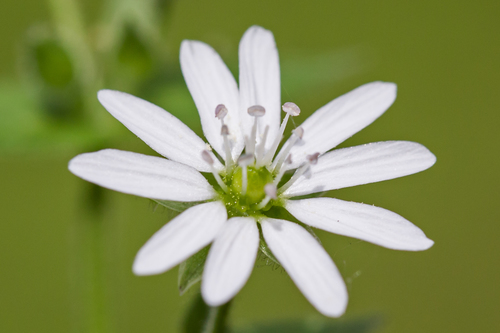
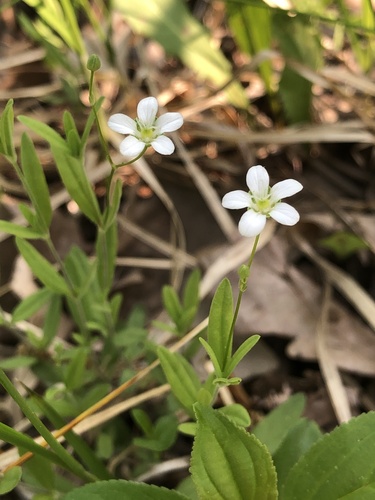
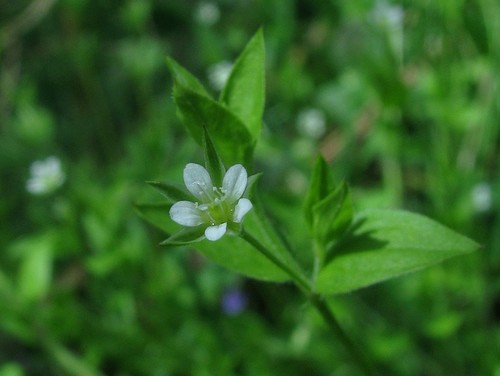
Moehringia trinervia, commonly known as three-nerved sandwort, is a small, slender, slightly hairy annual that grows 10 to 40 cm tall. Its leaves are 6 to 25 mm long, with three clearly visible longitudinal veins; some leaves can have up to five veins. Its flowers are around 6 mm in diameter, with each flower producing ten stamens and three styles. The sepals, which have three veins, are longer than the flower petals. This species flowers from April to July. Three-nerved sandwort is widely distributed across Britain and most of mainland Europe, but it does not grow in the Hebrides, Orkney, or Shetland. It prefers fertile, well-drained soils in old lowland deciduous woodland and hedgerows, and can be found at elevations up to 425 m. In Britain, it is recognized as an ancient woodland indicator in southern England, East Anglia, and Carmarthen. It can also grow in secondary woodland, and is able to recolonize habitats relatively quickly after disturbance. A Polish study conducted in Niepołomice Forest found that three-nerved sandwort accumulates large amounts of heavy metals from industrial pollution emissions in its tissues, particularly cadmium. The study concluded that high levels of heavy metal ions in this plant reflect heavy metal pollution levels in soil and the atmosphere, meaning three-nerved sandwort can be a useful bioindicator for this type of environmental pollution.