About Mitrephanes phaeocercus (P.L.Sclater, 1859)
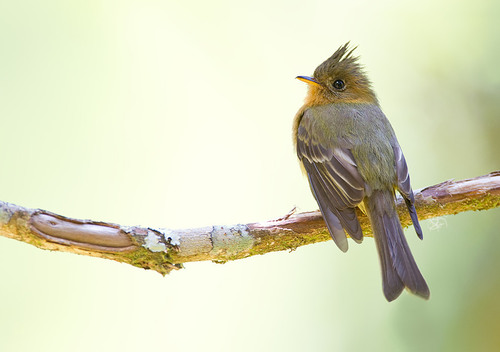
Mitrephanes phaeocercus, commonly known as the northern tufted flycatcher, measures 12 to 13.5 cm (4.7 to 5.3 in) in length and weighs approximately 8.5 g (0.30 oz). Both sexes share identical plumage, and all recognized subspecies have an erect pointed crest. For the nominate subspecies M. p. phaeocercus, adults have a brown-tinged olive crown, a pale spot above the lores, and a thin buff-white eye-ring on an otherwise cinnamon face. Their upperparts are brownish with an olive tinge. Their wings are dusky, with buff tips on the wing coverts that form two distinct wing bars, and whitish or pale yellow edges along the tertials. Their tail is dusky. The throat and breast are bright ochre to cinnamon, while the belly is ochre-yellow. Adults have a dark iris, a black upper mandible (maxilla), an orange-yellow lower mandible, and blackish legs and feet. Juveniles have a dark brown crown, with cinnamon-buff edges to the feathers of the crown and upperparts. Among the other subspecies, M. p. tenuirostris is paler and duller than the nominate subspecies. M. p. berlepschi has a darker olive crown than the nominate, along with yellowish lores, an olive back, an olive breast, olive wing bars, and a bright yellow belly. M. p. aurantiiventris is intermediate between the nominate and berlepschi, with medium olive upperparts and underparts that are more ochre than cinnamon. Each subspecies has a distinct distribution: M. p. tenuirostris occurs in western Mexico, from southeastern Sonora and southwestern Chihuahua south to western Jalisco. M. p. phaeocercus is found in the mountains of eastern and central Mexico, ranging from the latitude of Zacatecas south through Guatemala, northern El Salvador, and Honduras to far northeastern Nicaragua. M. p. aurantiiventris ranges from central Alajuela Province in Costa Rica east through Panama into the Serranía del Darién, stopping short of the Colombian border. M. p. berlepschi extends from extreme eastern Panama south through western Colombia, and slightly into the Esmeraldas and Carchi provinces of northwestern Ecuador. The northern tufted flycatcher has also been recorded as a vagrant in Texas and Arizona. This species inhabits a variety of wooded montane landscapes between the upper tropical and lower temperate zones. Its habitat includes pine, pine-oak, and evergreen forests, secondary forest, more open areas, and gallery forest. It generally favors forest edges, gaps, and clearings within forested areas. Its elevation range varies by region: in northern Central America it occurs between 1,200 and 3,000 m (3,900 and 9,800 ft); in Costa Rica between 500 and 3,000 m (1,600 and 9,800 ft); from near sea level to 1,200 m (3,900 ft) in Colombia; and between 100 and 600 m (300 and 2,000 ft) in Ecuador.