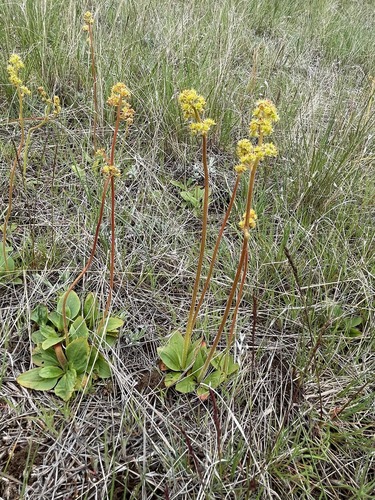
About Mitella diphylla L.
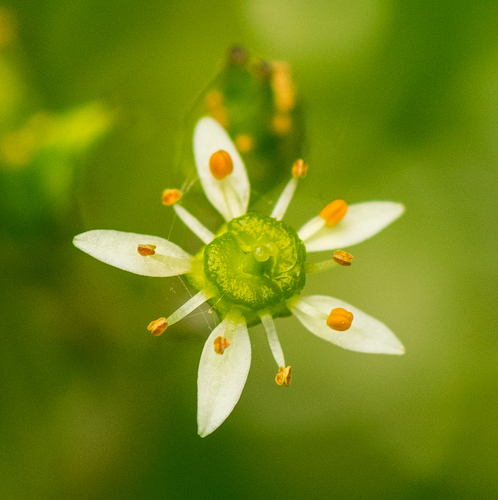
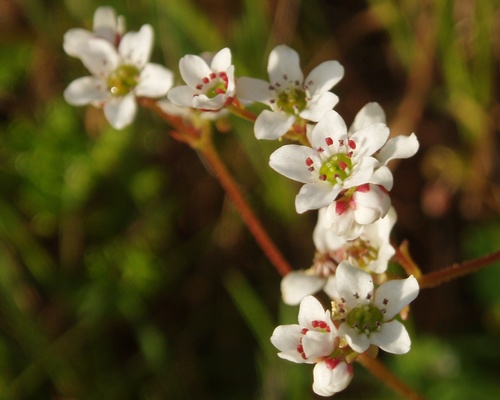
Mitella diphylla L., commonly called miterwort, grows from a rhizomatous root system made up of fibrous roots. Its leaves have coarse teeth and 3 to 5 shallow lobes. Most of the plant's leaves grow from the base, and each flower stalk bears one opposite pair of stemless leaves. In mid-spring, it produces tiny flowers with finely divided, lacy white petals arranged in racemes, on stems that reach 20 to 50 cm (8 to 20 inches) in height. The plant produces tiny seeds that measure 1.2–1.6 mm (0.05–0.06 inches). The seeds form in small green cups created from the flower's sepals; when ripe, the seeds are shiny and black. Seeds are dispersed when raindrops hit the cups and splash the seeds out. This species grows in high-quality mesic forests, on moist mossy ledges and north-facing slopes. The Latin specific epithet diphylla translates to two-leaved, and refers to the plant's non-basal leaves. In ecological terms, the flowers of Mitella diphylla produce both pollen and nectar. Because the flowers are very small, they are primarily visited by small bees and flies, including Lasioglossum sweat bees, small carpenter bees of the genus Ceratina, and hoverflies. This species is cultivated as an ornamental plant for shade gardens. It prefers partial shade and wet-mesic to dry soil.