About Misodendrum punctulatum Sol. ex G.Forst.
Nomenclature and Growth Form
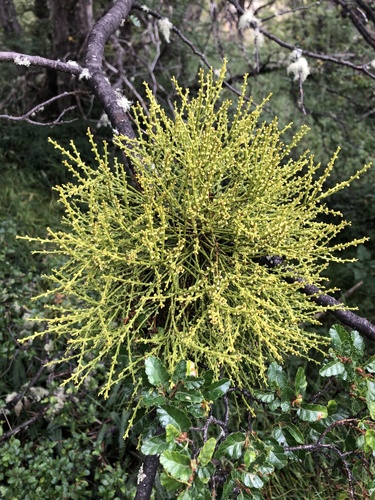
Misodendrum punctulatum Sol. ex G.Forst. grows as a small, highly branched bush reaching around 25 cm (10 inches) in height.
Growth Pattern
It has a sympodial growth pattern, meaning the apical meristem stops growing, and new growth continues from lateral meristems.
Leaf Characteristics
Its leaves are scale-like, with reduced photosynthetic activity.
Flowering Traits
Small flowers grow in spring, in the leaf axils of growth from the second year.
Fruit Characteristics
After flowering, the plant produces small achenes that have hairy bristles.
Achene Dispersal
These achenes are dispersed by wind, and their bristles become caught on tree branches.
Genus Dispersal Trait
Mistletoes in the genus Misodendrum are the only hemiparasites that are wind-dispersed.
Native Distribution and Altitude Range
Misodendrum punctulatum is native to the southern half of Chile and the foothills of the Patagonian Andes in southern Argentina, growing at altitudes up to approximately 2,000 m (6,562 ft).
Habitat by Altitude
At medium altitudes, it grows below the treeline, and at low altitudes it occurs in valleys.
Slope and Light Preference
It favors south-facing slopes in both light shade and deep shade.
Moisture Requirements
It needs humid conditions with abundant rainfall, and can only tolerate dry periods that last no more than one month.
Hemiparasitic Nature
Misodendrum punctulatum is a hemiparasite: it is partially photosynthetic, but also gets part of its required nutrients from a host plant.
Host Tree Species
It infects southern beech trees, including the deciduous species Nothofagus pumilio and Nothofagus antarctica, and the evergreen species Nothofagus dombeyi and Nothofagus betuloides.
Host Colonization Mechanism
It spreads to new host trees via its wind-carried seeds; the bristles on the seeds stick to small branches of suitable host trees.
Host Branch Age Preference
These host branches are usually less than four years old, which suggests germinating seedlings cannot penetrate thicker bark.
Post-Attachment Incubation Period
After a seed attaches to a host, there is an incubation period of several years, during which the new mistletoe plant gets all its nourishment from the host.
Aerial Shoot Development
Aerial shoots only develop after this incubation period ends.


