About Mischocyttarus mexicanus (de Saussure, 1854)
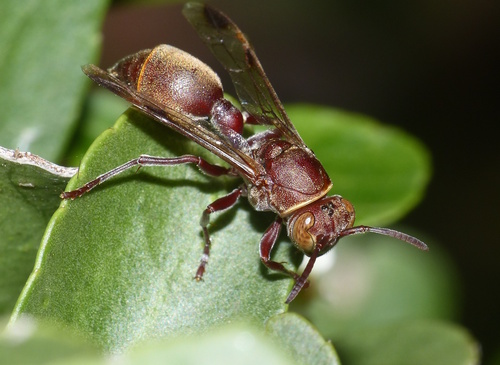
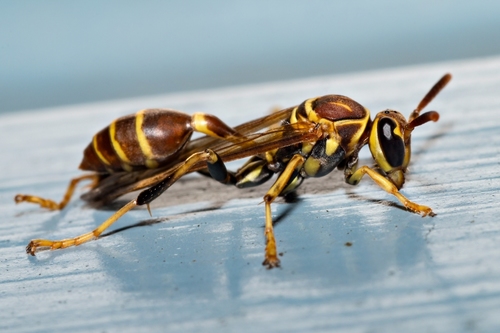
Description and identification: The genus Mischocyttarus can be recognized by two key traits: adult individuals have asymmetrical internal and external lobes on their tarsal segments, and mature larvae have appendix-like projections that extend forward from the abdominal sternum. M. mexicanus is part of a group of closely related similar species within the genus, which also includes Mischocyttarus flavitarsis and Mischocyttarus angulatus. This species group shares the characteristic of a sharp secondary margin on the pronotum, the dorsal surface of the prothorax. Additionally, male M. mexicanus have very short, thick antennae. Female individuals have a clypeus (a head plate) with a flattened apex. M. mexicanus typically has an orange-yellow body coloration.
Distribution and habitat: M. mexicanus is a New World wasp species found across a range extending from the southern United States down to Costa Rica. The nominate subspecies M. m. mexicanus occurs mainly between Mexico and Costa Rica, though it has also been recorded in Texas. The other subspecies, M. m. cubicola, has been observed in the southeastern United States, the Bahamas, Cuba, Puerto Rico, Texas, and Missouri. In Florida, M. m. cubicola has been recorded in nearly every county except the most northwestern counties of the state. It has been hypothesized that a distribution barrier runs through northwestern Florida, blocking this subspecies from spreading west of Alabama. However, M. m. cubicola was observed nesting in Texas and Missouri in 2009, where it nested in multiple palm species, other trees, and on human constructions.