About Miscanthus sinensis Andersson
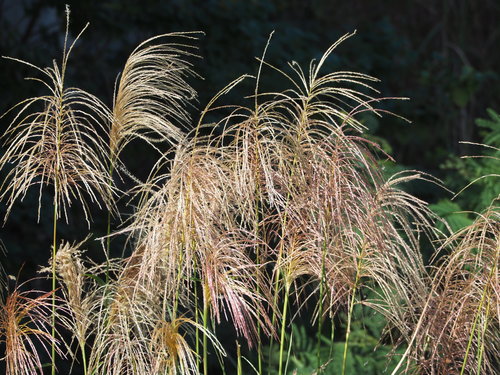
Miscanthus sinensis Andersson is an herbaceous perennial grass that grows 0.8–2 m (3–7 ft) tall, and rarely reaches 4 m (13 ft). It forms dense clumps from an underground rhizome. Its leaves measure 18–75 cm (7–30 in) long and 0.3–2 cm wide, and it produces purplish flowers held above its foliage. This grass is the preferred nesting structure for some paper wasp species, including Ropalidia fasciata. It is widely cultivated as an ornamental plant in temperate regions across the world. Miscanthus is a promising bioeconomy crop, but its current cultivation area in Europe is relatively low. This is most likely because it is considered an alternative crop, and there is limited knowledge about how to integrate it into modern farming systems. It can be grown in unfavorable conditions, including irregularly shaped plots, sloped land, and areas with relatively low soil quality. It also provides important ecological services such as soil protection, and farmers can use its on-farm biomass as animal feed. It can be cultivated in regions where corn grows, with an optimal altitude of up to around 700 meters. It grows particularly well in soils that are often too wet for traditional field crops like corn. Environmental factors including compacted soils and poor water retention can reduce biomass production and yield for bioenergy use. It has become an invasive species in parts of North America, but proper breeding and management can reduce the risk of it escaping cultivation or hybridizing with existing wild M. sinensis populations. M. sinensis is a candidate for bioenergy production, because it delivers stable yields across different climates and soil types, can be propagated inexpensively by seed, has effective nutrient cycling, and high genetic variation. It plays an important role as a renewable energy source to lower the environmental impact of grain-based ethanol production and improve energy security. The dry above-ground biomass, typically harvested in spring, can be burned directly in straw-fired power plants to generate electricity. It can also be used as feedstock to produce bioethanol via fermentation or biomethane via anaerobic digestion. Both bioethanol and biomethane are biofuels that can power various forms of transport, and serve as a scalable source of alternative fuel. Harvested raw M. sinensis is transported from fields to power plants or bioreactors as large bales, chopped straw, or pellets. Lignin content in M. sinensis hinders fermentation and reduces bioconversion efficiency. Harvesting green crop in autumn or early winter, adequate fertilization, and breeding for favorable traits can produce low-lignin Chinese silver grass that improves bioconversion efficiency. When developing new Miscanthus varieties for use as bioenergy crops, M. sinensis is a promising source of genetic material thanks to its favorable traits.