About Mirounga leonina (Linnaeus, 1758)
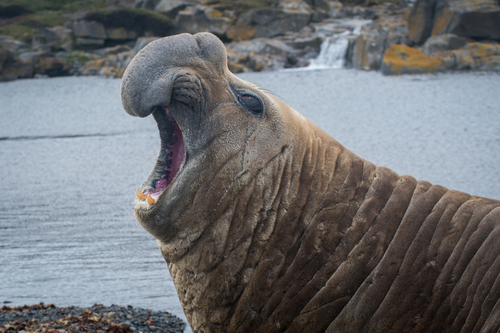
This species, the southern elephant seal (Mirounga leonina), can be distinguished from the non-overlapping northern elephant seal by its greater body mass and shorter proboscis. Southern males also appear taller when fighting, as they tend to bend their backs more strongly than the northern species. This species may show the largest mass-ratio sexual dimorphism of any mammal: males are typically five to six times heavier than females. On average, female southern elephant seals weigh 350 to 900 kg (770 to 1,980 lb) and measure 2.6 to 3 m (8.5 to 9.8 ft) long, while bulls range from 1,500 to 3,700 kg (3,300 to 8,200 lb) and grow 4.2 to 5.8 m (14 to 19 ft) in length. For comparison, in the other two large, highly size-dimorphic marine mammals, the northern elephant seal and the sperm whale (Physeter macrocephalus), males typically only outweigh females by a factor of three to four. Southern elephant seal size also varies by region. Studies show that elephant seals from South Georgia are around 30% heavier and 10% longer on average than those from Macquarie Island. The record-sized bull, shot in Possession Bay, South Georgia on 28 February 1913, measured 6.85 m (22.5 ft) long and was estimated to weigh 5,000 kg (11,000 lb), though it was only partially weighed piecemeal. The maximum recorded size for a female is 1,000 kg (2,200 lb) and 3.7 m (12 ft). A southern elephant seal has large, round, black eyes. The wide set of the eyes and a high concentration of low-light pigments indicate that sight plays an important role in prey capture. Like all seals, elephant seals have hind limbs whose ends form the tail and tail fluke. Each of the "feet" has five long, webbed digits. This agile paired structure is used to propel the seal through water, while the pectoral fins are used very little during swimming. Though their hind limbs are not suited for moving on land, elephant seals use their fins for support to propel their bodies across land. They can move quickly this way, up to 8 km/h (5.0 mph), for short-distance travel: to return to water, catch up with a female, or chase an intruder. Pups are born with completely black fur. Their birth coats are not suited for water, but insulate the young seals from cold air. The first moult occurs alongside weaning. After moulting, coats may turn grey or brown, depending on the thickness and moisture of the new hair. In older males, the skin forms a thick leathery layer that is often scarred. Like other seals, the vascular system of elephant seals is adapted to cold environments: small veins surround arteries to capture heat from them. This heat-retention structure is found in extremities such as the hind legs. The global southern elephant seal population was estimated at 650,000 in the mid-1990s, and estimates from 2005 put the population between 664,000 and 740,000. Studies confirm three distinct geographic subpopulations, one located in each of the three southern oceans. Tracking studies mapping the routes southern elephant seals travel have shown their main feeding area is at the edge of the Antarctic continent. While elephant seals may occasionally come ashore in Antarctica to rest or mate, they gather to breed in subantarctic locations. The largest subpopulation is in the South Atlantic, with over 400,000 individuals, including individuals on Gough Island and around 113,000 breeding females on South Georgia. Other breeding colonies of the Atlantic subpopulation are found on the Falkland Islands and Valdes Peninsula in Argentina, which is the only continental breeding population for the species. The second subpopulation, in the southern Indian Ocean, has up to 200,000 individuals. Three-quarters of these seals breed in the Kerguelen Islands, with the remainder breeding in the Crozet Islands, Marion and Prince Edward Islands, and Heard Island. Some individuals also breed on Amsterdam Island. The third subpopulation, of around 75,000 seals, is found on subantarctic islands of the Pacific Ocean south of Tasmania and New Zealand, with Macquarie Island being the main breeding site. Colonies once existed in Tasmania, Saint Helena, and the Juan Fernández Islands off the coast of Chile. Individual seals moulting have occasionally been found in South Africa, Australia or Uruguay. Stray individuals have also been reported periodically on the shores of Mauritius, with two reports from the Río Guayas estuary area in Ecuador and a beach in Lima, Peru. The so-called Manatee of Helena has been suggested to be a misidentification of southern elephant seals that historically occurred on Saint Helena. In Chile, the species is currently thought to be re-colonizing its former range; for example, it has been sighted in the 2010s at the mouth of Toltén River and at the Caicura Islets. After large-scale commercial seal hunting ended in the 19th century, southern elephant seals recovered to a sizable population by the 1950s. Since that time, an unexplained decline has occurred in the Indian Ocean and Pacific Ocean subpopulations. The overall population now appears to be stable, though the reasons for this historical fluctuation remain unknown. Proposed explanations include population depression after a rapid demographic rebound that depleted vital resources, climate change, competition with other species whose populations also changed, or even negative impacts from scientific monitoring techniques. Southern elephant seals are among the seals that can stay on land for the longest continuous periods, remaining dry for several consecutive weeks each year. Males arrive at breeding colonies earlier than females, and fight for control of harems once they arrive. Large body size gives males an advantage in fights, and the agonistic interactions between bulls create a dominance hierarchy that determines access to harems and activity within them. Dominant bulls, called "harem masters", establish harems that can include several dozen females. The least successful males have no harems, but may attempt to copulate with a harem master's females when the dominant male is not present. Most first-time breeding females, and a significant proportion of multiparous females, mate at sea with roaming males outside of harems. A breeding male must stay in his territory to defend it, which can mean going months without eating, surviving entirely on stored blubber. Two fighting males use their weight and canine teeth against each other. Fights are rarely fatal, and the defeated bull flees, but bulls often receive severe tears and cuts. Some males can stay ashore for over three months without food. Males commonly produce a characteristic coughing roar, which is used for individual recognition and size assessment between males. Conflicts between high-ranking males are more often resolved through posturing and vocalization than physical combat. Pups are generally born quickly during the breeding season. After birth, a newborn will bark or yap, and its mother responds with a high-pitched moan. The newborn begins suckling immediately. Lactation lasts an average of 23 days, and the female fasts for the entire duration of this period. Newborns weigh about 40 kg (88 lb) at birth, and reach 120 to 130 kg (260 to 290 lb) by weaning. The mother loses a significant amount of weight during lactation. Weaned young seals gather in nurseries until they shed their birth coats. They then enter the water to practice swimming, usually starting in sheltered estuaries or ponds. In summer, southern elephant seals come ashore to moult, which sometimes occurs immediately after breeding.