About Mirounga angustirostris (Gill, 1866)
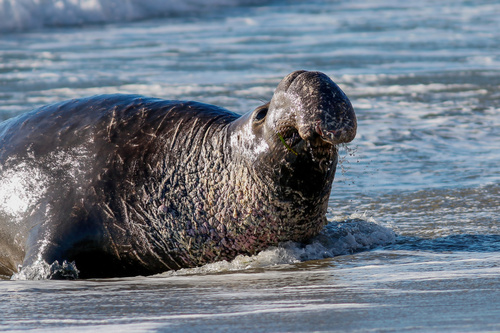
Mirounga angustirostris, commonly known as the northern elephant seal, displays extreme sexual size dimorphism. Adult males are typically 1,500–2,300 kg (3,300–5,100 lb) in weight and 4–5 m (13–16 ft) in length, though some individuals can reach up to 3,700 kg (8,200 lb). Females are much smaller, weighing roughly one-third of a male’s bulk at 400 to 900 kg (880 to 1,980 lb) and measuring 2.5 to 3.6 m (8.2 to 11.8 ft). Compared to southern elephant seals, male northern elephant seals are smaller on average than male southern elephant seals, while females of both species are around the same size, meaning southern elephant seals have an even higher degree of sexual dimorphism. Northern elephant seals have a typical lifespan of around nine years. Pups are born with dark, nearly black fur that they shed after weaning to turn silvery grey. As they mature, both juveniles and adults undergo annual molting, where their fur changes from black to a coat ranging from silver to deep grey, which eventually fades to tan. The necks and chests of adult males are furless, with a speckled pattern of pink, white, and light brown; the thicker, calloused skin on their neck acts as a protective shield during mating season fights. Northern elephant seals have large, round, black eyes. The wide spacing of their eyes and a high concentration of low-light pigments indicate that sight is important for capturing prey. Like all seals, northern elephant seals have atrophied hind limbs whose underdeveloped ends form the tail and tail fluke. Each of the hind feet has five long, webbed digits, and this agile paired structure is used to propel the seal through water, while the pectoral fins are used very little during swimming. While hind limbs are not suited for walking on land, northern elephant seals use their fins for support to move their bodies across land. They can move quickly over short distances at up to 8 kilometres per hour (5.0 mph; 4.3 kn) this way, when returning to water, pursuing females, or chasing intruders. Like other seals, northern elephant seals have circulatory adaptations to cold environments: a network of small veins surrounds arteries to capture heat from arterial blood, and this structure is found in extremities such as the hind limbs. A unique physiological trait of the northern elephant seal is its ability to store oxygenated red blood cells (RBCs) in its spleen. A 2004 study used MRI to observe spleen changes in five seal pups during simulated dives, and found that by the three-minute mark, spleens had on average contracted to one-fifth of their original size, showing that dive activity triggers sympathetic contraction of the spleen. The study also recorded a delay between spleen contraction and an increase of hematocrit in circulating blood, which was attributed to the hepatic sinus. This fluid-filled structure expands when RBCs flow out of the spleen, then slowly releases the red blood cells into the circulatory system via a muscular vena caval sphincter located on the cranial side of the diaphragm. This slow release of RBCs likely prevents harmful effects from a rapid spike in hematocrit. The northern elephant seal is found in the eastern Pacific Ocean. Individuals spend most of their time at sea, only coming ashore to give birth, breed, and molt at rookeries located on offshore islands or isolated mainland beaches. Most of these rookies lie in California and northern Baja California, spanning from Point Reyes National Seashore, California to Isla Natividad, Mexico. Major breeding colonies are located at the Channel Islands, Año Nuevo State Reserve, Piedras Blancas Light, and the Farallon Islands in the United States, and at Isla Guadalupe, Isla Benito del Este and Isla Cedros in Mexico. The species’ breeding range has expanded northward in recent decades. The first pup was recorded at Point Reyes in 1976, and a breeding colony was established there in 1981. Some breeding activity has been recorded at Castle Rock in Northern California and Shell Island off Oregon since the mid-1990s, and the first confirmed northern elephant seal births in British Columbia occurred at Race Rocks in January 2009. The California breeding population is now demographically isolated from the Baja California population. Northern elephant seals show extreme sexual dimorphism in feeding behavior. After leaving rookeries, males migrate north to feeding grounds along the continental shelf from Washington to the western Aleutians in Alaska, where they mostly feed on benthic organisms living on the ocean floor. Females head north or west into open ocean after leaving rookeries, foraging across a large area of the northeastern Pacific that extends as far west as Hawaii. They feed mainly on pelagic organisms living in the water column. Vagrant individuals occasionally appear in tropical regions such as the Mariana Islands. The historical presence of northern elephant seals, whether permanent or occasional, in the western North Pacific is not well understood. There are two confirmed records of vagrants reaching the Japanese coast: a male on Niijima in 1989, and a young seal on beaches in Hasama, Tateyama in 2001. A 2.5-metre (8 ft 2 in) female was found on Sanze beach, Tsuruoka, Yamagata in October 2017, marking the first record of the species from the Sea of Japan. This individual was severely weakened but showed signs of recovery after receiving treatment at Kamo Aquarium, and the aquarium discussed whether to release her. Some individuals have been observed on the coast of northeast Asia. A small number of individuals established haul-out sites at the Commander Islands in the early 2000s, but long-term colonization is not expected due to aggressive interactions with local Steller sea lions. Males typically dive directly down to the ocean floor and stay on the seabed to forage for benthic prey. Females hunt pelagic prey in open ocean, dive deeper than males (reaching up to 1,735 metres (5,692 ft), with an average depth of around 500 metres (1,640 ft)), and stay submerged for longer periods than males. Tagged female northern elephant seals have been recorded diving almost continuously for 20 hours or more per day, mostly in water 400 to 600 metres (1,310 to 1,970 ft) deep, where small fish are abundant. Northern elephant seals eat a wide range of prey, including mesopelagic fish such as myctophids, deep-water squid, Pacific hake, pelagic crustaceans, small sharks, rays, and ratfish. Octopoteuthis deletron squid is a common prey; one study found this species in the stomachs of 58% of individuals sampled off the coast of California. In 2013, a deep-sea camera documented a female northern elephant seal consuming a Pacific hagfish at a depth of 894 m (2,933 ft), slurping it from the ocean floor. This observation was reported by a Ukrainian boy named Kirill Dudko, who shared the finding with Canadian scientists. Northern elephant seals do not need to drink fresh water, as they get all required water from their food and from fat metabolism. When hunting in dark deep water, northern elephant seals appear to locate prey at least partially using vision, and the bioluminescence of some prey can help them detect targets. They do not have a developed echolocation system like cetaceans, but their vibration-sensitive vibrissae are thought to play a role in searching for food. The main predators of northern elephant seals are orcas and great white sharks. Both predators most often target pups and rarely hunt large adult bull seals, but they have been recorded preying on seals of all ages. Great white sharks typically ambush adult seals with a damaging bite, then wait for the seal to weaken from blood loss before feeding. Northern elephant seals return to their terrestrial breeding grounds in December and January, with bulls arriving first. Bulls haul out on isolated, protected beaches, usually on islands or very remote mainland locations that offer shelter from winter storms and high surf. Bulls fight for dominance to determine which individuals will gain a harem of females. After males arrive on the beach, females come ashore to give birth. Females fast for five weeks while nursing their single pup, which lasts for four weeks; during the last few days of lactation, females enter estrus and mate. Mating status follows a social hierarchy, where larger, stronger males hold higher rank. This is a polygynous mating system, where a high-ranking bull can control a harem of 30–100 females, depending on his size and strength. Males that cannot establish harems wait at the edge of the colony and attempt to mate with nearby females. Dominant bulls interrupt copulations by lower-ranking males, and will often stop mating to chase off rivals. Fights between bulls are not usually fatal, but they are brutal and often cause significant bleeding and injury; when opponents are poorly matched, younger, less capable males are usually just chased away, often to upland dunes. Over its lifetime, a successful bull can easily sire more than 500 pups. Only a small number of males in a breeding colony complete most copulations, and most other males may never mate. Copulation usually happens on land and takes approximately five minutes. Pups are sometimes crushed to death during fights between bulls. After coming ashore, males fast for three months, while females fast for five weeks during mating and pup nursing. The total gestation period is about seven months, but the fertilized egg does not implant into the uterine wall until four months after copulation. This process, called delayed implantation, allows females to time their arrival at breeding beaches to align with when they will give birth. One study found that the vast majority of births happen at night, within established harems. Immediately after giving birth, a female turns toward her pup and produces a warbling vocalization to draw the pup to her, and continues using this call throughout lactation. Some females become very aggressive after giving birth and will defend their pup from other females, and this aggression is more common on crowded beaches. While most females nurse only their own pup and refuse to let unrelated pups nurse, some do allow alien pups to nurse alongside their own. Orphaned pups may try to find another female to suckle, and some are adopted, at least on Año Nuevo Island. Some pups, called super weaners, grow to exceptionally large sizes by nursing from multiple females in addition to their own mother. Pups nurse for approximately four weeks, then are abruptly weaned and abandoned by their mother, who returns to sea within a few days. Pups gain weight quickly during nursing, and average 136–181 kg (300–400 pounds) at weaning. Left alone on shore, weaned pups gather into groups and remain on land for 12 more weeks, learning to swim in the surf before venturing farther out to forage, at which point their first long journey at sea begins. Northern elephant seals communicate through multiple different methods. Males threaten each other with snorts, produced by expelling air through their probosces, and clap-traps, which are loud clapping sounds comparable to the noise of a diesel engine. Pups vocalize when stressed or when prompting their mothers to let them nurse. Females produce a non-pulsed attraction call when responding to their young, and a harsh, pulsed call when threatened by other females, males, or alien pups. Northern elephant seals produce low-frequency sounds, both transmitted through substrate and through air. These sounds help maintain social hierarchy in crowded or noisy environments and reduce energy consumption while individuals are fasting.