About Mirbelia speciosa Sieber ex DC.
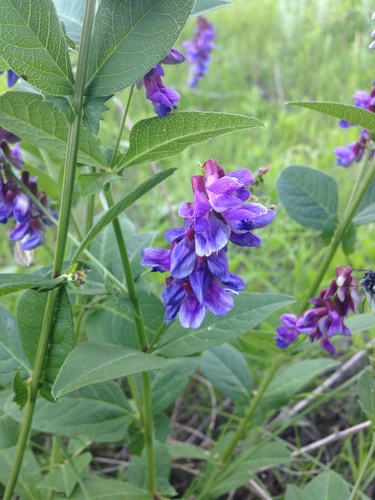
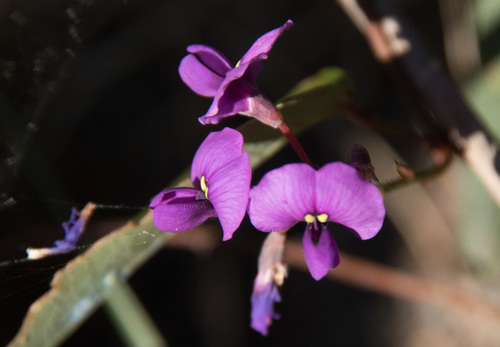
Mirbelia speciosa (Mirbelia speciosa Sieber ex DC.) is an erect shrub that usually grows to a maximum height of about 1 meter (3 feet 3 inches), and has angular stems. Its leaves are arranged in whorls of three, are narrowly linear, 10–30 mm (0.39–1.18 in) long, 2–4 mm (0.079–0.157 in) wide, with a sharp point and rolled under edges. Flowers are mostly arranged in leaf axils. Sepals are 6–8 mm (0.24–0.31 in) long, covered in silky hairs, and joined at the base to form a tube with tapering teeth about as long as the tube. Petals are 8–13 mm (0.31–0.51 in) long, bluish-purple, and often have a yellowish mark near the base of the standard petal. Flowering takes place in July and August, and the fruit is an oval pod 8–15 mm (0.31–0.59 in) long. This species of Mirbelia grows in heath, woodland, and forest, ranging north from the Illawarra region in New South Wales to north Queensland. For cultivation, this species is not recommended for poorly drained clay soils or sites with excessive frost. It prefers full sun, but grows better with a small amount of shade. Fertilizers may be used, but only low pH (more acidic) fertilizers are recommended. This plant roots easily from tip cuttings. Seed propagation is also successful; seeds can be treated with very hot (not boiling) water for two minutes, dried overnight, then planted and placed in a sunny position. Germination usually occurs within two weeks.