About Mirbelia rubiifolia (Andrews) G.Don
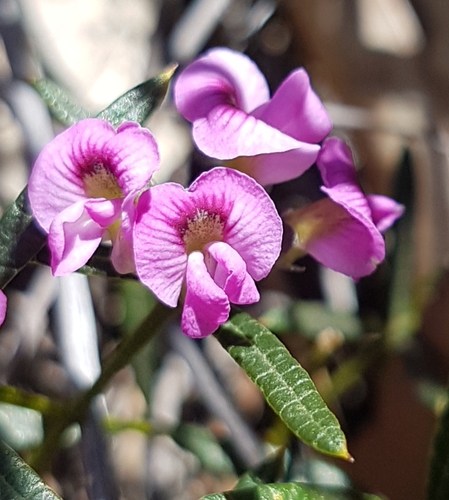
Mirbelia rubiifolia (Andrews) G.Don is a diffuse, spreading shrub that typically grows up to 50 cm (20 in) tall. It has angular stems, which are sometimes covered with soft hairs pressed against the stem surface. Its leaves are arranged in whorls of three, and are narrowly egg-shaped to lance-shaped or linear. Most leaves are 10–25 mm (0.39–0.98 in) long and 2–4 mm (0.079–0.157 in) wide, with a sharply pointed tip, and grow from a petiole up to 1 mm (0.039 in) long. The upper leaf surface has a conspicuous network of veins, and the lower leaf surface sometimes has a few scattered hairs. The flowers are arranged in clusters in leaf axils, or in racemes at the ends of branches, growing from silky-hairy pedicels up to 2 mm (0.079 in) long. The sepals are 3–4 mm (0.12–0.16 in) long and joined at the base, with the upper two lobes almost completely fused together. The petals are 8–9 mm (0.31–0.35 in) long, and range in color from pink to purple, rarely white. The standard petal is kidney-shaped, and the keel is much shorter than the wings. Flowering occurs from October to December, and the fruit is an oval pod about 5 mm (0.20 in) long. This species, commonly called heathy mirbelia, grows in sclerophyll forest, woodland, and heath habitats on sandy soils in coastal or tableland areas, and is often found in locations that are prone to inundation. Its distribution extends from Croajingolong National Park in Victoria, northward through New South Wales to Queensland. Mirbelia rubiifolia is rarely cultivated, but adapts well to a part-shaded spot in a subtropical garden. Supplementary watering during dry periods is beneficial for the plant. It can grow as an untidy, scrambling shrub, and often looks better after pruning.