About Mionectes striaticollis (Orbigny & Lafresnaye, 1837)
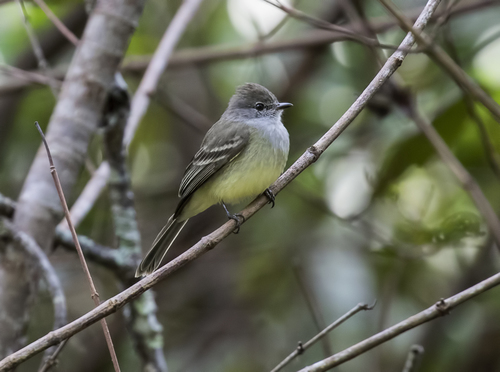
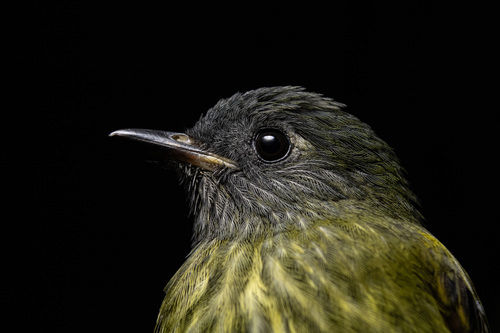
The streak-necked flycatcher (Mionectes striaticollis, first described by Orbigny & Lafresnaye in 1837) is 13 to 13.5 cm (5.1 to 5.3 in) long and weighs 13 to 17 g (0.46 to 0.60 oz). Males and females have identical plumage. Adults of the nominate subspecies M. s. striaticollis have a dark gray face marked with white streaks and a small white spot behind the eye. Their crown and nape are slaty gray, and the rest of their upperparts are dark olive. Their wings and tail are olive, and sometimes show faint buffish olive wing bars. Their throat and upper breast are slate-gray with white streaks, their lower breast and flanks are streaked with dark olive and yellow, and their belly is yellow. Subspecies M. s. columbianus has a dark olive-gray crown, a grayish olive face, and a gray throat and upper breast with thin white streaks. Subspecies M. s. palamblae has an olive wash over its gray face and crown, and a gray chin. Its throat and upper breast are streaked dark olive and yellow, and its lower breast and belly are yellow. Subspecies M. s. viridiceps has a dark olive crown, a dark gray face, and an olive throat and upper breast with thin white streaks. For all subspecies, both sexes have a dark brown iris, a long dark brownish gray bill with a pinkish base to the lower mandible, and dark gray legs and feet. Each subspecies of streak-necked flycatcher has a separate distribution in the Andes. M. s. columbianus is found in the Colombian Andes except southwestern Colombia, and on the eastern Andean slope of Ecuador. M. s. viridiceps occurs on the west slope of the Andes in far southwestern Colombia, and extends south along the west slope through Ecuador. M. s. palamblae lives on the west slope of the Andes in northern Peru, from near the Ecuadorian border south to Huánuco Department. M. s. striaticollis is found on the east slope of the Andes of Peru from Pasco Department south into northern Bolivia, reaching as far as western Santa Cruz Department. The streak-necked flycatcher primarily lives in humid montane forest in the upper tropical and lower temperate zones. It also occurs at forest edges and in secondary forest. Its elevation range varies by location: between 1,500 and 2,700 m (4,900 and 8,900 ft) in Colombia; mostly between 1,500 and 2,500 m (4,900 and 8,200 ft) in Ecuador, with local occurrence at lower elevations; between 1,700 and 3,100 m (5,600 and 10,200 ft) on the west slope in Peru; and between 500 and 3,300 m (1,600 and 10,800 ft) on the east slope in Peru, though it mostly occurs between 1,000 and 2,400 m (3,300 and 7,900 ft) there.