About Mionectes oleagineus (Lichtenstein, 1823)
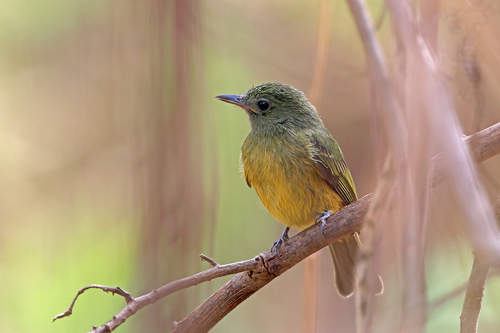
The ochre-bellied flycatcher (scientific name Mionectes oleagineus (Lichtenstein, 1823)) measures 12.5 to 14 cm (4.9 to 5.5 in) in length and weighs 7.5 to 18.5 g (0.26 to 0.65 oz). Both sexes share identical plumage. Adults of the nominate subspecies M. o. oleagineus have a greenish olive head, nape, back, and rump. Their wings are olive, with wide buffy ochraceous edges on the tertials and thinner buffy ochraceous edges on the coverts that form visible wing bars. Their tail is dark grayish brown or dusky olive, and their throat and underparts are rich cinnamon buff. Other subspecies differ slightly from the nominate. M. o. assimilis has no buffy ochraceous edges on its wing coverts. The wing covert edges are small on M. o. abdominalis and M. o. dorsalis, so their wing bars are fainter than those of the nominate. M. o. abdominalis has somewhat grayer upperparts and breast than the nominate. All non-nominate subspecies have a variable olive wash on their throats. For all subspecies, both sexes have a dark brown iris, a black maxilla, a black mandible with a variably colored but paler base, and legs and feet in various shades of gray.
The ochre-bellied flycatcher's subspecies are distributed across the Americas as follows. M. o. assimilis ranges from Veracruz, Oaxaca, and the Yucatán Peninsula in southern Mexico south along both the Caribbean and Pacific slopes through Central America into western Panama. M. o. parcus ranges from the Canal Zone in eastern Panama across west-central and northern Colombia into northwestern Venezuela as far as western Trujillo state, and extends south into the valleys of Colombia's Cauca and Magdalena rivers. M. o. abdominalis occurs in the Venezuelan Coastal Range from Yaracuy east to the Capital District and Miranda's Cerro Negro. M. o. pallidiventris lives on Trinidad, Tobago, and in the northeastern Venezuelan states of Anzoátegui, Sucre, Monagas, and Delta Amacuro. M. o. dorsalis is found on the Chimantá and Roraima tepuis in southern Venezuela. M. o. pacificus ranges from Nariño Department in far southwestern Colombia south along the western Andean slope through western Ecuador into far northwestern Peru's Tumbes Department. M. o. oleagineus (the nominate subspecies) occurs in the eastern half of Colombia, southeastern Venezuela, the Guianas, the Amazon Basin of Brazil, eastern Ecuador, eastern Peru, and northern Bolivia, with a separate population in coastal southeastern Brazil between Paraíba and Rio de Janeiro states.
The ochre-bellied flycatcher generally inhabits the interior and edges of humid to wet evergreen forest, semi-deciduous forest, and nearby secondary forest in tropical and subtropical zones. It can also be found in gallery forest, plantations, and gardens, and occupies both várzea and terra firme forest within the Amazon Basin. Its elevational range varies by region: it occurs from sea level to 1,800 m (5,900 ft) in northern Central America, to 1,200 m (3,900 ft) in Costa Rica, to 1,300 m (4,300 ft) in Colombia, and to 1,400 m (4,600 ft) in western Venezuela. In eastern Venezuela excluding the tepuis, it reaches 1,800 m (5,900 ft), and it occurs between 1,450 and 1,850 m (4,800 and 6,100 ft) on Venezuela's tepuis. In Brazil it ranges from sea level to 1,800 m (5,900 ft), it occurs mostly below 1,000 m (3,300 ft) in Ecuador, and below 1,300 m (4,300 ft) in Peru.