About Mionectes galbinus Bangs, 1902
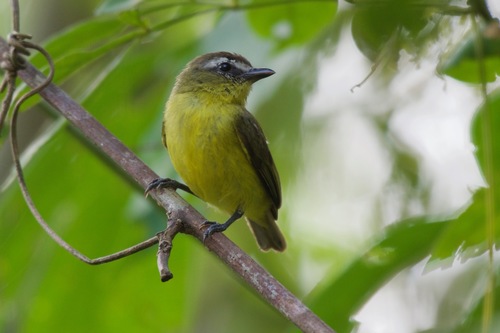
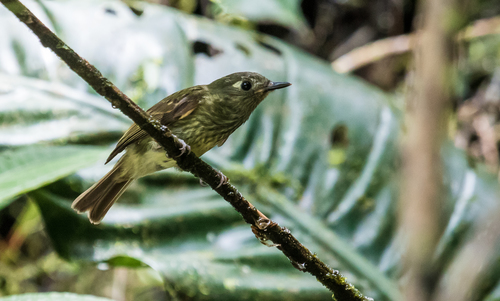
The olive-striped flycatcher (scientific name Mionectes galbinus Bangs, 1902) measures 13 to 13.5 cm (5.1 to 5.3 in) in length and weighs 10 to 17.5 g (0.35 to 0.62 oz). Both sexes share identical plumage. For the nominate subspecies M. g. galbinus, adults have a face streaked with dark olive and yellowish white, and a small white spot behind the eye. Their crown, nape, and upperparts are yellow green, while their wings and tail are dusky olive with thin yellowish green edges on the flight feathers. Their throat and upper breast are streaked with dark olive and yellowish white; their lower breast and flanks are streaked with dark olive and yellow, and their belly is unstreaked pale yellow. Compared to the nominate subspecies, M. g. hederaceus has darker upperparts, more whitish and dark grayish olive throat streaks, and a paler yellowish white belly. M. g. venezuelensis has a darker crown, slightly darker upperparts, and paler yellow underparts than the nominate. M. g. fasciaticollis has uniform dark olive upperparts and richer yellow underparts than the nominate. For both sexes of all subspecies, the iris is dark brown, the bill is black with an orange base in older birds, and the legs and feet are dark gray or pinkish.
The four subspecies of the olive-striped flycatcher have separate distribution ranges: M. g. hederaceus is found from Veraguas Province in central Panama south through northern and western Colombia and western Ecuador almost to Peru; M. g. galbinus is restricted to the isolated Sierra Nevada de Santa Marta in northern Colombia; M. g. venezuelensis occurs in the Venezuelan Coastal Ranges between Falcón and Sucre states, the Serranía del Perijá on the Venezuela-Colombia border, south along Colombia's Eastern Andes to Meta Department, and on Trinidad; M. g. fasciaticollis ranges from far southern Colombia's Putumayo Department south on the eastern slope of the Andes through Ecuador and Peru into extreme northwestern Bolivia.
The olive-striped flycatcher lives in the interior and edges of humid forest, secondary forest, and plantations in the foothills and subtropical zone. It typically occurs from the forest understory to its middle levels, and favors areas of dense vegetation such as that found in damp shady ravines. Its elevation range varies by region: from sea level to 1,800 m (5,900 ft) in Panama and Colombia; between 150 and 3,000 m (500 and 9,800 ft) in Venezuela, with most populations occurring between 900 and 2,300 m (3,000 and 7,500 ft); from near sea level to 2,000 m (6,600 ft) in western Ecuador; between 400 and 2,000 m (1,300 and 6,600 ft) in eastern Ecuador; and generally between 300 and 1,400 m (1,000 and 4,600 ft) in Peru, reaching as high as 2,100 m (6,900 ft) locally.