About Minois dryas (Scopoli, 1763)
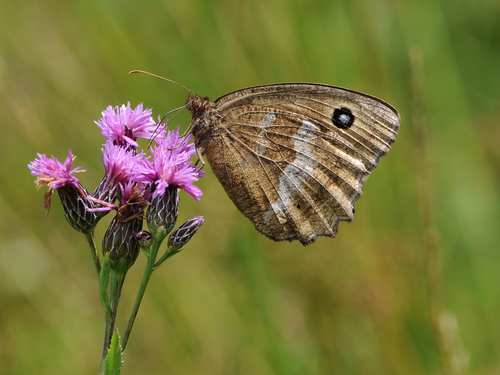
Minois dryas, first formally described by Scopoli in 1763, has a wingspan ranging from 54 to 70 millimetres, or 2.1 to 2.8 inches. The basic color of the upper surface of its wings is dark brown. Females of this species are larger and paler in color than males. Each forewing has two large eyelets with bluish pupils, while each hindwing only has one small eyelet. The underside of the wings looks quite similar to the upperside. However, the forewing eyelets on the underside have a yellowish border, and the hindwings on the underside are mainly gray brown. This species looks very similar to Satyrus actaea and Satyrus ferula; in Satyrus ferula, the forewing eyespots have white centers. This species is distributed across southern and central Europe, extending through to central Asia and Japan. It most commonly occupies mixed woodland margins and sunny grasslands with abundant flowers, at elevations between 100 and 1,600 metres, or 330 to 5,250 feet, above sea level.