About Mimosa tenuiflora (Willd.) Poir.
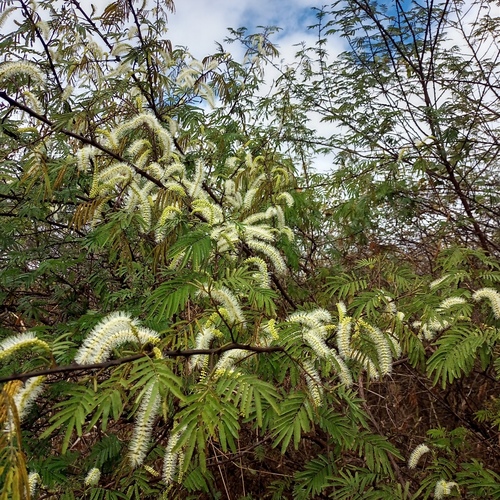
Mimosa tenuiflora (Willd.) Poir. has fern-like branches with finely pinnate, Mimosa-like leaves that reach 5 cm (2.0 in) in length. Each compound leaf holds 15–33 pairs of bright green leaflets that measure 5–6 mm (0.20–0.24 in) long. This tree can grow up to 8 m (26 ft) tall, and can reach 4–5 m (13–16 ft) tall in under 5 years. Its white, fragrant flowers grow in loosely cylindrical spikes 4–8 cm (1.6–3.1 in) long. In the Northern Hemisphere, it blossoms and produces fruit from November through June or July; in the Southern Hemisphere, it primarily blooms from September to January. The fruit is brittle, averaging 2.5–5 cm (0.98–1.97 in) long. Each pod contains 4–6 oval, flat, light brown seeds that are 3–4 mm (0.12–0.16 in) in diameter, with approximately 145 seeds per 1 g (0.035 oz). In the Southern Hemisphere, fruit ripens from February to April. The tree's bark is dark brown to gray, splits lengthwise, and has a reddish brown inner layer. Its wood is dark reddish brown with a yellow center, and is very dense, durable and strong, with a density of about 1.11 g/cm³. Mimosa tenuiflora recovers very well after forest fires or other major ecological disturbances, and is a prolific pioneer plant. It continuously drops leaves onto the ground to form a thin layer of mulch that eventually becomes humus. Along with its ability to fix nitrogen, the tree conditions soil to make it suitable for other plant species to grow. In medicinal uses, a tea made from the leaves and stem has been used to treat tooth pain. A water decoction of Mimosa tenuiflora is drunk to treat cough and bronchitis. This preparation is made by steeping a handful of bark in one liter of water, and can be used on its own or mixed into a syrup; the solution is drunk until symptoms subside. One preliminary clinical study found Mimosa tenuiflora effective for treating venous leg ulcerations. Aqueous extracts of the plant are widely used for wound healing and treating burns in Central and South America. As a result, plant products generally grouped under the term "Tepezcohuite" have become a popular, easily produced cosmetic ingredient in commercial skincare products. In other uses, the tree is an acceptable source of forage or fodder for animals, providing important protein and other nutrients. It grows well through the dry season and drought, providing life-saving food for local livestock and wildlife. Cows, goats and sheep eat its pods and leaves. Evidence suggests that using Mimosa tenuiflora as forage or fodder causes developmental defects to pregnant ruminants in Brazil. It is also an important source of forage for bees, especially during the dry season and the start of the wet season. Like most plants in the family Fabaceae, Mimosa tenuiflora fertilizes soil with the help of nitrogen-fixing bacteria. The tree is useful for preventing soil erosion and for reforestation. It is a very good source of fuel wood, and works very well for making posts, most likely due to its high 16% tannin content that protects it from rot. Thanks to its high tannin content, the bark is widely used as a natural dye and in leather production. The wood is used to make bridges, buildings, fences, furniture and wheels. It is an excellent source of charcoal, and at least one study has investigated what makes it suitable for this use. The tree's healing properties make it useful for treating domestic animals. A solution of leaves or bark can be used to wash animals to prevent parasites. Because it retains most of its leaves during the dry season, it is an important source of shade for animals and plants at that time. Mimosa tenuiflora is an entheogen used by the Jurema Cult (O Culto da Jurema) in northeastern Brazil. Dried Mexican Mimosa tenuiflora root bark has been found to have a dimethyltryptamine (DMT) content of about 1–1.7%, while stem bark has about 0.03% DMT. Parts of the tree are traditionally used in northeastern Brazil to make a psychoactive decoction also called Jurema or Yurema. This is analogous to the traditional Western Amazonian sacrament Ayahuasca, which is brewed from indigenous ayahuasca vines. However, to date no β-carbolines such as harmala alkaloids have been detected in Mimosa tenuiflora decoctions, though Jurema is used in combination with several other plants. This creates challenges for the pharmacological understanding of how DMT from the plant becomes orally active as an entheogen, because ingested DMT requires a monoamine oxidase inhibitor (MAOI) such as a β-carboline to be psychoactive. If no MAOI is present in the plant or added to the mixture, the enzyme monoamine oxidase (MAO) will metabolize DMT in the human gut, preventing the active molecule from entering the blood and brain. The plant is also used in the clandestine manufacture of crystalline DMT, which is psychoactive on its own when vaporized and inhaled. In 2005, a new class of phytoindoles called yuremamine was isolated from Mimosa tenuiflora, which may explain the apparent oral activity of DMT in Jurema. For outdoor cultivation, USDA Zone 9 or higher is recommended. In its natural habitat, Mimosa tenuiflora fruits and seeds are disseminated by the wind within a 5–8 m (16–26 ft) radius from the mother plant; rain carries seeds from slopes to lower plains, and human activities also contribute to dissemination. For cultivation, seed pods are collected once they begin to open spontaneously on the tree. Collected pods are laid out in the sun to open and release their seeds. Seeds can then be planted in sandy soil with full sun exposure. Scarifying seeds via mechanical methods or with sulfuric acid greatly increases germination rate compared to untreated seeds. Seeds can be sown directly into holes in the ground or planted in prepared growing areas. Seeds can germinate at temperatures between 10 to 30 °C, but the highest germination rate (around 96%) occurs at approximately 25 °C, even after four years of storage. Germination takes about 2–4 weeks. Mimosa tenuiflora can also be propagated from cuttings. Trimming adult trees during the rainy season is not recommended, as it can kill them.