About Mimetes hirtus (L.) Knight
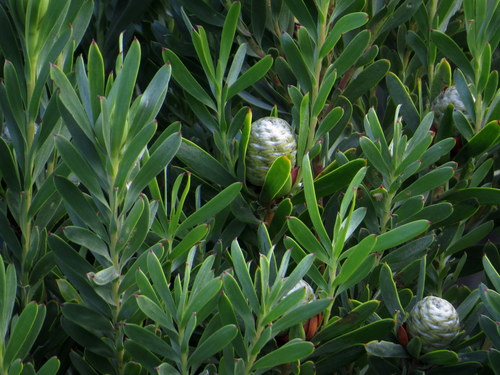
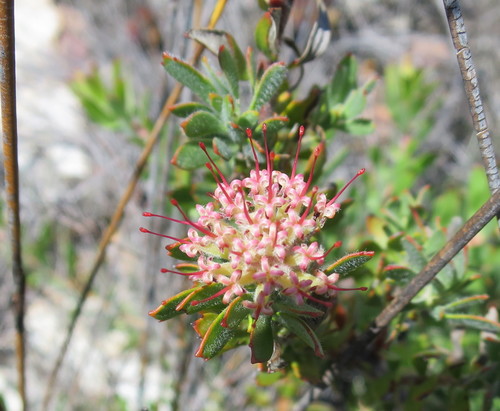
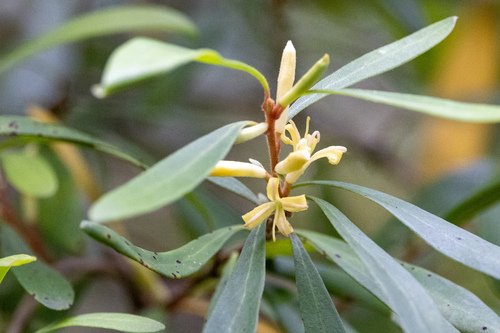
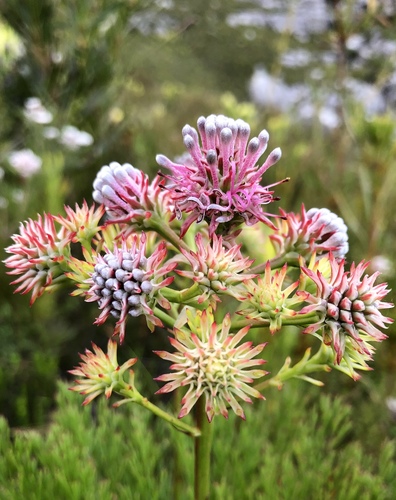
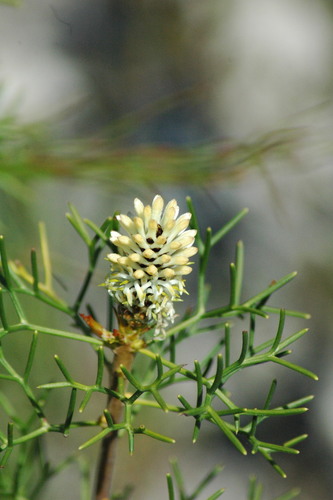
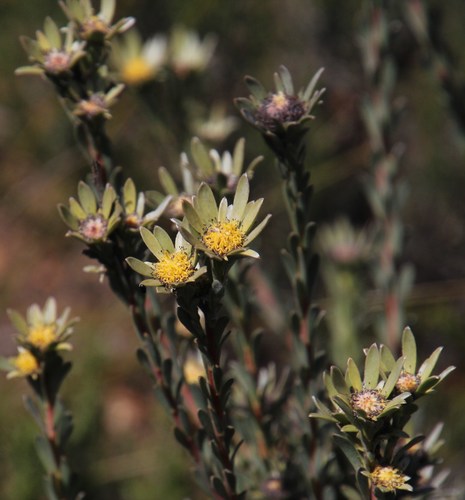
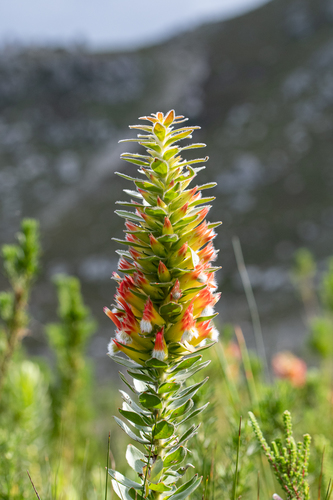
Mimetes hirtus, commonly called marsh pagoda, is an evergreen, well-branched, upright shrub that grows 1½–2 m (5–6½ ft) tall. It develops from a single trunk up to 7½ cm (3 in) thick, covered in smooth red bark. Its stiffly upright branches are initially covered in dense felty or woolly hairs, which wear off quickly. Leaves are arranged alternately along branches, pointing upward and overlapping. They have a lance-shaped to broadly lance-shaped outline, 2½–4½ cm (1.0–1.8 in) long and ½–1¾ cm (0.2–0.7 in) wide, with a pointed thickened tip. Initially, leaves have some felty hairs and a row of felty hairs along the entire margin, which wear off over time. The inflorescences are broadly cylinder-shaped, 8–14 cm (3¼–5¾ in) long and 8–9 cm (3¼–3½ in) in diameter, capped with a tuft of smaller, pinkish, weakly upright leaves. Each inflorescence holds up to fourteen flower heads, each containing nine to fourteen individual flowers, that sit in the axil of an ordinary flat green leaf. The outer whorl of bracts encircling the flower heads is bright yellow with red tips, pointed lance-shaped, 1½–4 cm (0.6–1.6 in) long and ½–1¼ cm (0.2–0.5 in) wide. These bracts are papery, mostly hairless but sometimes with a few silky hairs, with a row of silky hairs on margins toward the tip, and tightly wrap around the flowers. Inner bracts are narrowly lance-shaped with a pointed tip, sickle-shaped, thinly papery, 2–4 cm (0.8–1.6 in) long and 4–6 mm (0.12–0.16 in) wide, with slight silky hair along the margins. The bract subtending each individual flower is line-shaped to awl-shaped, 5–8 mm (0.20–0.32 in) long and about 1 mm (0.04 in) wide, hairless except for a row of minute hairs along its edges. The 4-merous perianth is 3–4 cm (1.2–1.4 in) long and straight. Its lower merged section, which remains joined when the flower opens, is square in cross-section, hairless, and about ½ cm (0.2 in) long. The middle claw segments are thread-shaped, with light powdery hair near the base and silky hair toward the top. The upper limb segments, which enclose the pollen presenter in the bud, are line-shaped with a pointed tip, boat-shaped, and covered in silky hairs. The four anthers have no filament and each is directly fused to one of the limbs. A red-colored style 5–5½ cm (2.0–2.2 in) long, slightly bent, emerges from the center of the perianth. The thickened tip of the style, called the pollen presenter, is about 4 mm (0.16 in) long, with a ring-shaped thickening at its base, and the stigmatic groove sits across the very tip. The ovary is egg-shaped, covered in fine minute powder, and about 2 mm (0.04 in) long. It is subtended by four fleshy, blunt, rounded rectangular scales about 2 mm (0.08 in) long. The ovary develops into a cylindrical fruit 6–7 mm (0.24–0.28 in) long and 1½–2 mm (0.06–0.08 in) wide. This endemic species grows along the foot of coastal mountains on the southern coast of the Western Cape province of South Africa. In the west, wild populations grow on the Cape Peninsula, between Buffelsbaai and Silvermine Nature Reserve; historically, the species ranged as far north as Rondebosch. Further east, its range extends from Hangklip near Pringle Bay, along the foot of Kogelberg Nature Reserve at Betty's Bay and Kleinmond, through Hermanus, to the southern foot of the hills toward Elim, which marks its southeastern limit. It seldom grows at altitudes exceeding 50 m (165 ft), except for populations at Silvermine and Highlands which occur around 400 m (1300 ft) elevation. It prefers swampy habitat or stream banks, where it may form dense stands and grows alongside species such as Osmitopsis asteriscoides, Erica perspicua and Psoralea aphylla. Like other Mimetes species, the marsh pagoda is adapted to bird pollination, most effectively by the Cape sugarbird. This bird sits on top of the inflorescence and brushes against the pollen presenters. Visits from orange-breasted sunbirds are less effective, because this species sits below the inflorescence and largely avoids contact with pollen presenters. After fruits fall, native ants collect the fruits and carry them to their underground nests. Ants eat the elaiosome at the seed surface, leaving the hard grey seeds protected from consumption and fire. Seeds germinate after an overhead fire followed by rains. Like most shrubs in its habitat, the marsh pagoda is short-lived. It grows vigorously initially, often starting to flower as early as its second year. It continues growing and flowering profusely until around fifteen years of age, when old age sets in.