About Mimetes argenteus Knight
Mimetes argenteus, also known as the silver pagoda, is an evergreen, open, upright shrub. It usually reaches a maximum height of 2 m (6 ft), and rarely grows to 3½ m (11½ ft) tall. It grows from a main stem up to 8 cm (3 in) thick, which is covered in smooth, thin grey bark, with new shoots growing from near the base of the plant. These shoots are upright, sparsely branching, 6–10 mm (0.24–0.40 in) thick. They are initially densely felty, but the hair wears away as the plant ages, and are reddish pink near the tip.
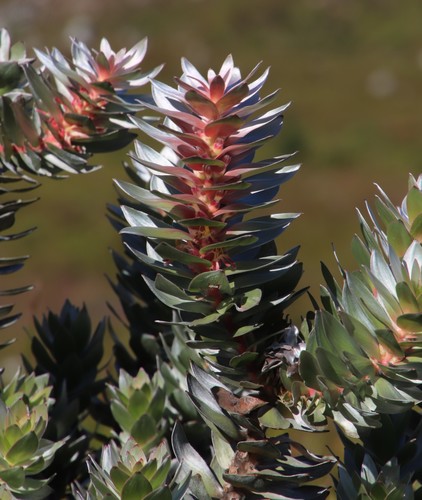
The leaves are arranged alternately along the shoots, have no stipules or leaf stalk, and grow at right angles to the shoots. They are elliptic or broadly elliptic, 4–6½ cm (1.6–3.6 in) long and 1¾–3½ cm (0.7–1.4 in) wide. They are silvery greyish white due to a very dense covering of fine silky hair pressed to the leaf surface, and also have silky hairs along their edges. Each leaf ends in a pointed tip with a thickening, and rarely ends in three crowded teeth.
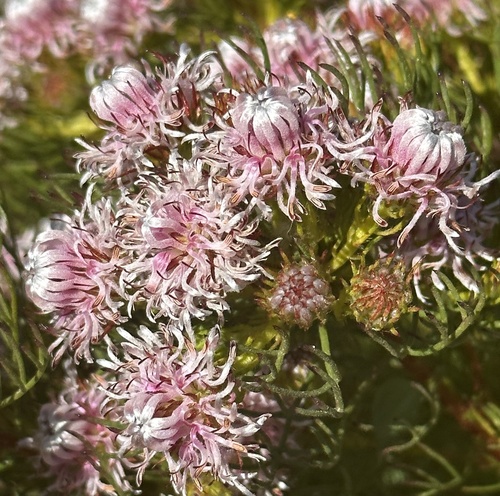
The inflorescence is broadly cylindrical, 8–15 cm (3–6 in) long and 10–12 cm (4–5 in) in diameter, topped by smaller silvery pink leaves that grow at an upright angle. The inflorescence is made up of many flower heads, each containing 6 to 9 individual flowers. Each flower head is located in the axil of a regular flat leaf that is flushed mauve to carmine, especially at its base. The outer whorl of bracts that neatly enclose the flower heads is initially cartilaginous, becoming woody with age. These bracts are carmine, bluntly oval, ¾–1½ cm (0.3–0.6 in) long and ½–¾ mm (0.2–0.3 in) wide, with a powdery outer surface and a row of minute hairs along the edge. The bracts on the inside of the flower head are narrow, 1–1¼ cm (0.4–0.5 in) long and about ¼ cm (0.1 in) wide, and are densely covered in silky hairs. The bract that sits below each individual flower is pointed and line-shaped, ¾–1 cm (0.3–0.4 in) long and about 1 mm (0.04 in) wide, covered in dense silky hairs.
The 4-merous perianth is 2½–3 cm (1.0–1.2 in) long. The lower part, which remains merged when the flower opens, is very short, hairless and slightly inflated. The four segments in the middle part (or claws) are line-shaped and densely covered in silky hairs. The segments in the upper part (or limbs), which enclose the pollen presenter when in bud, are line-shaped with a pointed tip, bear some silky hairs, and are about 1 cm (0.4 in) long. A yellow, straight, thread-shaped style 4–4½ cm (1.6–1.8 in) long emerges from the centre of the perianth. The thickened section at the tip of the style, called the pollen presenter, is line-shaped with a pointed tip, narrower where it connects to the style, and has a groove that acts as the stigma across its tip; it is 7–8 mm (about ⅓ in) long. The egg-shaped ovary is covered in powdery hairs, about 2 mm (0.04–0.08 in) long, and is surrounded by four line- to awl-shaped scales at its base. The ovary develops into an egg-shaped fruit with a fleshy, whitish, oily covering, which eventually reaches about ¾ cm long and ½ cm across.
The silver pagoda occurs from the area around Sir Lowry's Pass in the west, along the cool south-facing slopes of the southern mountains, especially the Hottentots Holland and Riviersonderend Mountains, to Appelskraal in the east. It grows in sandstone fynbos vegetation, at an altitude of 600–1000 m (1950–3250 ft), rarely reaching up to 1500 m (4900 ft). Within this habitat, it prefers seepage zones on well-drained peaty soil. Its flowers are pollinated by birds. Fruits ripen 2–6 months after flowering and fall to the ground, where they are collected by native ants that carry them to their underground nests. After the ants eat the sweet, whitish elaiosome covering of the seed, the seed remains safely underground, protected from fire and predation by birds and rodents. This species cannot survive fire, and re-establishes itself from stored seed after fire events.