About Mimas tiliae Linnaeus, 1758
Mimas tiliae, commonly known as the lime hawk-moth, is a moth species in the family Sphingidae. It is distributed across the entire Palearctic region, the Near East, and northern Spain in Europe. The species was first formally described by Carl Linnaeus in 1758, in the 10th edition of his work Systema Naturae.
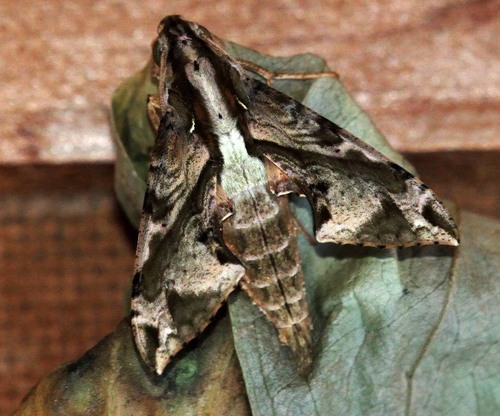
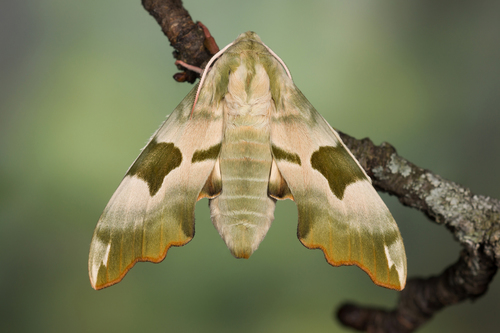
This species shows considerable variation, but its markings make it distinguishable from all other Palearctic sphingid moths. The ground color of its forewings is pinkish or buff, and darkens toward the tornus. The forewings are marked with one or two dark green or brown blotches, which sometimes merge to form a continuous band across the middle of the wing. Hindwings are plainer, and colored grey or buffish brown. The wingspan of Mimas tiliae ranges from 70 to 80 millimetres (2+3⁄4–3+1⁄8 inches).
The species displays sexual dimorphism. Males are usually smaller, but have more distinct markings than females. Typically, female forewings have a brownish ground color, while male forewings are distinctly green, though many exceptions to this pattern exist. When adult females emerge, their abdomen is straight and plump, and already contains fully formed eggs – this trait is shared with all species in the tribe Smerinthini. In contrast, the male abdomen is slender and strongly curved.
Documented forms of the species are: f. brunnea Bartel, with a brown ground color; f. pallida Tutt, with a grey ground color; f. lutescens Tutt, with a yellow ground color; f. virescens Tutt, with a green ground color; f. transversa Tutt, where the dark median forewing band is entire; f. tiliae, where the dark median band is narrowly separated; and f. obsoleta Clark, where the dark median band is completely absent.
This moth is active at night during May and June, and is attracted to light. Adult lime hawk-moths do not feed. Full-grown larvae are green with yellow and red markings along their sides, and have a blue horn at the hind end, which is typical for species in this family. Larvae feed mainly on lime trees, but have also been recorded feeding on other trees and shrubs. When larvae are ready to pupate, their color changes to purple-grey, and they wander to find a suitable pupation site. The species overwinters as a pupa in the soil at the base of its host tree.
Recorded food plants for Mimas tiliae include: Alnus (alder), Betula (birch), Morus (mulberry), Prunus, Quercus (oak), Tilia (lime), and Ulmus (elm).