About Milvus milvus (Linnaeus, 1758)
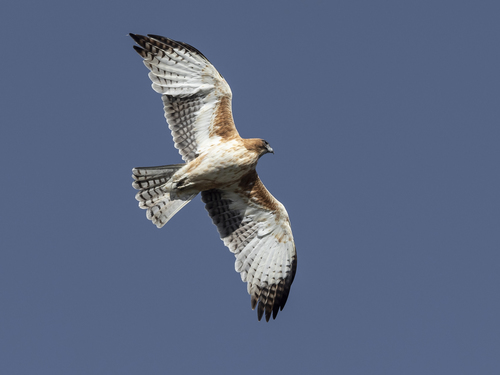
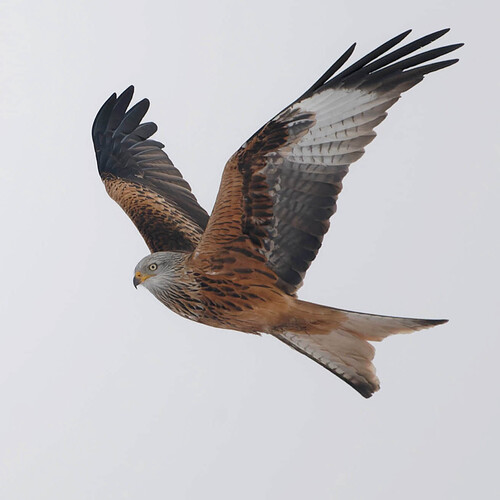
Red kites (Milvus milvus) measure 60 to 70 cm (24 to 28 in) in length, with a wingspan of 175–195 cm (69–77 in). Males weigh 800–1,200 g (28–42 oz), while females weigh 1,000–1,300 g (35–46 oz). This is an elegant bird that soars on long wings held in a dihedral position, with a long forked tail that twists as the bird changes direction. Its body, upper tail, and wing coverts are rufous; white primary flight feathers contrast with black wing tips and dark secondaries. Apart from the weight difference, males and females have similar plumage, but juvenile red kites have a buff breast and belly. The red kite's call is a thin piping sound, similar to that of the common buzzard but less mewling. A rare white leucistic form exists, making up approximately 1% of hatchlings in the Welsh red kite population, and this variation reduces survival odds.
Red kites live in broadleaf woodlands, pastures, mixed farmland, valleys, and wetland edges, occurring up to at least 1,600 metres (5,200 ft) elevation. They are native to the western Palearctic, and all currently known breeding pairs numbering 32,200–37,700 are located in Europe. Historically, breeding populations also existed in western Asia (northern Iran, Syria, and Turkey) and northwestern Africa (Algeria, Morocco, and Tunisia), but most of these populations were extirpated in the 19th century or earlier. The only non-European breeding population in recent decades was in Morocco, where the last known breeding pair was recorded in 2004.
Today, red kites breed from Portugal and Spain, through the central part of the European continent east to European Russia, north to southern Scandinavia, Latvia, and the United Kingdom, and south to southern Italy; very few if any breeding red kites remain in the Balkans. Most red kites that breed on northern European mainland historically moved south or west for winter, typically wintering in Spain and other mild-climate parts of western Europe, as well as northwestern Africa (Algeria, Morocco, and Tunisia) and Turkey. In recent decades, an increasing number of red kites from the northern European mainland have stayed in their breeding region year-round.
Between 1990 and 2000, populations in Germany which alone hosts almost half of the world's breeding pairs, France, and Spain declined; overall the species declined by almost 20% over that ten-year period. Populations in Germany and France have since stabilised, and as populations have grown in other regions, the overall global population of red kites is now increasing.
The main threats to red kites are poisoning, from both illegal direct poisoning and indirect poisoning from pesticides, particularly in the wintering ranges of France and Spain. Changes in agricultural practices have also reduced available food resources for the species. Other threats include electrocution, hunting and trapping, deforestation, local-scale egg collection, and potential competition with the generally more successful black kite (M. migrans).
Red kites are generalist scavengers and predators. Their diet consists mainly of carrion from large domestic animals such as sheep and pigs, roadkill, and stranded fish. They also hunt small mammals including mice, voles, shrews, stoats, and young hares and rabbits. They catch live birds as well, especially young or wounded individuals, such as crows, doves, starlings, thrushes, larks, gulls, and waterfowl. Occasionally they will take reptiles and amphibians, and invertebrates such as earthworms form an important part of their diet, especially in spring.
In some parts of the United Kingdom, people deliberately feed red kites in domestic gardens, which explains the presence of red kites in urban areas. Up to 5% of householders in these areas provide supplementary food for red kites, with chicken being the most common meat provided. As scavengers, red kites are particularly susceptible to poisoning. Illegal poison baits set for foxes or crows are non-selective, and kill protected birds including red kites and other animals. There have also been multiple incidents of red kites and other raptors being specifically targeted by wildlife criminals. On rare occasions, red kites may steal food directly from humans. One documented incident occurred in Marlow, Buckinghamshire, a town near a major UK red kite reintroduction site in the nearby village of Stokenchurch, where red kites swooped down to steal sandwiches from people in a town park.