About Milvus migrans (Boddaert, 1783)
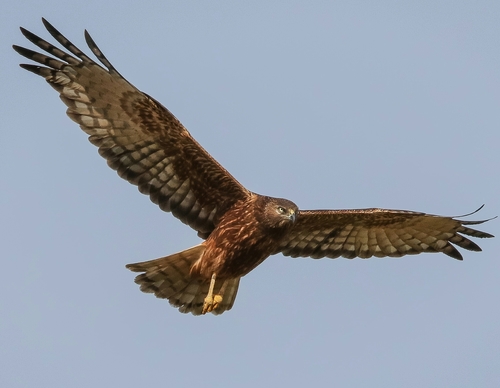
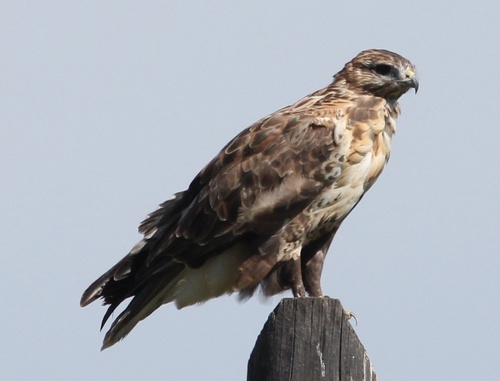
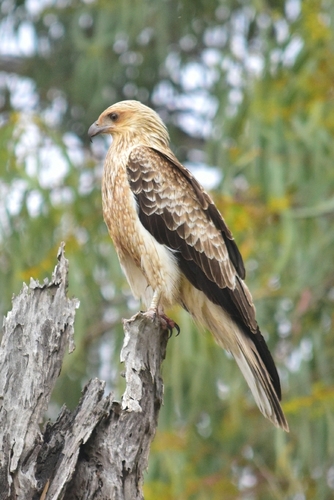
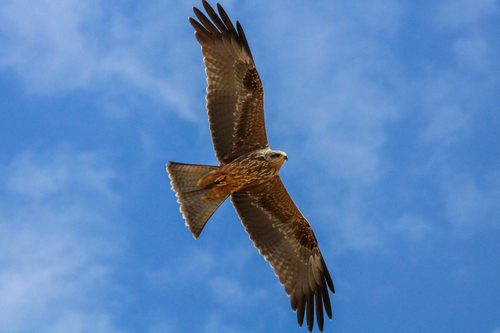
Black kites (Milvus migrans) can be distinguished from red kites by their slightly smaller size, less forked tail that is visible in flight, and generally dark plumage with no rufous colouring. The sexes have similar appearances, though the male is a little smaller and less aggressive, a pattern seen in most birds of prey. On average, black kites weigh 735 grams (25.9 oz). Their upper plumage is brown, while the head and neck tend to be paler. The patch behind the eye is noticeably darker. The outer flight feathers are black; these feathers have dark cross bars and are mottled at their base. The lower parts of the body are pale brown, lightening in colour toward the chin. Body feathers have dark shafts that create a streaked appearance. Unlike the yellow-billed kite, the black kite has a black bill, while its cere and gape are yellow. The legs are yellow and the claws are black. Black kites have a distinctive call: a shrill whistle followed by a rapid whinnying sound. While males and females share the same plumage, females are longer than males and have a slightly larger wingspan. The overall wingspan of a black kite is around 150 cm (5 ft).
This species is found across Europe, Asia, Africa and Australia. Temperate populations of this kite are typically migratory, while tropical populations are resident. European and central Asian birds, corresponding to subspecies M. m. migrans and black-eared kite M. m. lineatus respectively, are migratory and travel to the tropics for winter. Races in warmer regions, such as the Indian M. m. govinda (small Indian kite) or the Australasian M. m. affinis (fork-tailed kite), are resident. In some areas like the United Kingdom, the black kite only occurs as a wandering migrant. These visiting birds are usually of the nominate race, but in November 2006 a juvenile of the eastern subspecies lineatus, which had not previously been recorded in western Europe, was found in Lincolnshire. The species is not present in the Indonesian archipelago between the South East Asian mainland and the Wallace Line. Vagrants, most likely black-eared kites, sometimes range far into the Pacific, reaching as far out as the Hawaiian Islands. In India, the population of M. m. govinda is particularly large, especially in areas with high human population. These birds avoid heavily forested regions here. A 1967 survey covering 150 square kilometres (58 sq mi) of the city of New Delhi produced an estimate of about 2200 pairs, or roughly 15 pairs per square kilometre. Another 2013 survey estimated 150 pairs for every 10 square kilometres (3.9 sq mi). Vagrants from Australia occasionally reach New Zealand; however, only one individual has persisted there, and this individual is currently approximately 21 years old.
Black kites are most often seen gliding and soaring on thermals while searching for food. Their flight is buoyant; the bird glides effortlessly, and changes direction easily. They will swoop down with legs lowered to snatch small live prey, fish, household refuse and carrion. Due to this scavenging behaviour, they are known as shite-hawk in British military slang. They are opportunistic hunters, and have been recorded preying on birds, bats, and rodents. They are attracted to smoke and fires, where they seek out escaping prey. In northern Australia, kites have been observed spreading wildfires by picking up and dropping burning twigs to flush out prey, leading them to be called "firehawks" in some circles. Indian populations of black kites are well adapted to living in cities, and are found in densely populated areas. Large numbers may be seen soaring in thermals over cities. In some places, they will readily swoop and snatch food held by humans. When people throw meat into the air, kites will dive-bomb to catch it. Humans nearby may suffer serious injury from the kites' sharp talons. Repeated exposure to close human contact and being fed has decreased the kites' fear of humans. In Spain, black kites prey on nestling waterfowl, especially during the summer when feeding their young. Predation on the nests of other black kite pairs has also been recorded. Kites have also been observed tearing apart and carrying away the nests of baya weavers in an attempt to take eggs or chicks.