About Millettia grandis (E.Mey.) Skeels
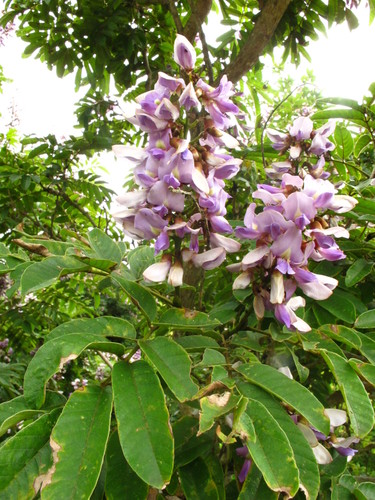
Millettia grandis (E.Mey.) Skeels is a semi-deciduous tree that grows 10 to 25 meters tall. Its stem is usually twisted or bent, and it often branches low down. Younger branches have smooth bark, while older branches and stems have flaky bark. The bark ranges in color from pale brown to pale grey-brown, and some stems appear reddish when stained by termite soil. Its compound leaves hold 3 to 7 pairs of opposite, lance-shaped leaflets plus one terminal leaflet. Individual leaflets measure 20 to 50 mm long, and full leaves can reach up to 250 mm in total length. The upper surface of leaves is glossy dark green or blue-green, while the lower surface is yellow-green. Fine silky hairs cover the leaf undersides and the leaf midrib. Older leaves turn yellow, and the trees lose most of their leaves during the dry winter months. New leaves grow in quickly after leaf drop; new leaves are initially reddish-brown and velvety. The flowers resemble wisteria flowers, and range in color from mauve to lilac to purple. The fruits are flat, woody pods that grow up to 150 mm long by 40 mm wide, and are covered in a velvety layer of reddish to golden brown hairs. When dry, the pods split open, often with a loud popping noise, to release flat, oblong seeds that grow easily in fine sandy soil. This tree is found in coastal regions of KwaZulu-Natal (excluding Maputaland) and the Eastern Cape Province of South Africa. It is most common in the Pondoland area of the Eastern Cape, and grows in forests and on forest margins.