About Microtis unifolia (G.Forst.) Rchb.f.
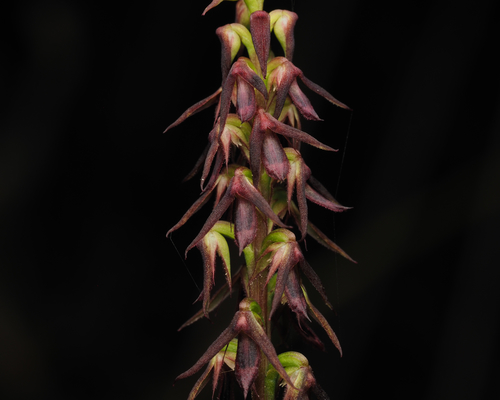
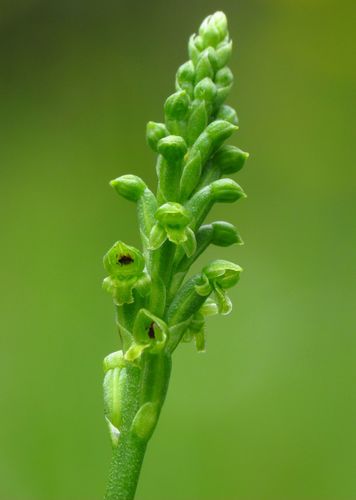
Microtis unifolia (G.Forst.) Rchb.f. is a terrestrial, perennial, deciduous herb that grows from an underground tuber. It produces a single hollow, green leaf between 100–800 mm (4–31 in) long. A flowering stem up to 600 mm (24 in) tall emerges from the leaf, at about one-third of the leaf’s length from its base. Between 10 and 100 green or yellowish-green flowers are arranged along a 30–130 mm (1–5 in) section of the flowering stem. Each flower has a lance-shaped to egg-shaped bract at its base, measuring 2–4 mm (0.08–0.2 in) long and roughly 1.5 mm (0.06 in) wide. The ovary is more or less oval, 3–4 mm (0.1–0.2 in) long, borne on a short, relatively thick pedicel, and projects outward from the stem. The dorsal sepal is egg-shaped to nearly circular, 2–4 mm (0.08–0.2 in) long and 1–2 mm (0.04–0.08 in) wide, and forms a hood that covers the other internal parts of the flower. The lateral sepals are lance-shaped to egg-shaped, around 2 mm (0.08 in) long and 1 mm (0.04 in) wide, and spread apart from each other. The petals are lance-shaped or egg-shaped and curved, shorter than the dorsal sepal, and are partly hidden by the dorsal sepal. The labellum is oblong, 1–2.5 mm (0.04–0.1 in) long, and pressed against the ovary. Its edges are notched, wrinkled or wavy, and there is a saddle-shaped callus in its centre. Flowering occurs from October to January in Australia, and somewhat later in New Zealand. This species grows in a wide range of habitats, from swamps to rocky outcrops in semi-arid areas. It is common in disturbed areas such as pine plantations. In New Zealand, it also grows in urban lawns and even in mossy crevices of old buildings. Microtis unifolia is a variable species, and its similarity to other Microtis species has caused confusion over the full extent of its range. It is confirmed to occur in New South Wales, Queensland, South Australia and Victoria in Australia, as well as on both main islands and many smaller islands of New Zealand. Its distribution also extends to New Caledonia, Polynesia, the Philippines, Indonesia, Japan and China.