About Microtis arenaria Lindl.
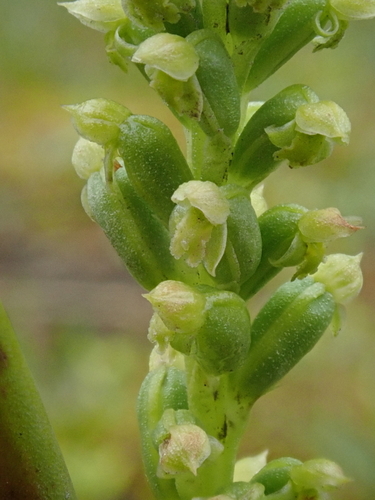
Microtis arenaria Lindl. (common name pale onion orchid) is a terrestrial, perennial, deciduous herb that grows from an underground tuber. It produces a single erect, smooth, tubular leaf that is 300 to 800 mm (10 to 30 in) long and 6 to 7 mm (0.2 to 0.3 in) wide. Between ten and sixty yellowish-green, fragrant flowers are densely arranged along a flowering stem that reaches 350 to 600 mm (10 to 20 in) in height. Each individual flower measures 3 to 3.5 mm (0.12 to 0.14 in) long and 2 to 2.5 mm (0.08 to 0.1 in) wide. The dorsal sepal is egg-shaped, 2.5 mm (0.1 in) long and wide, with a slightly upturned tip. The lateral sepals are 2.5 mm (0.1 in) long, about 1 mm (0.04 in) wide, with their tips rolled inward under the flower. The petals are curved and lance-shaped, about 2 mm (0.08 in) long and 1 mm (0.04 in) wide, and are positioned under the dorsal sepal. The labellum curves downwards, and is 2 to 2.5 mm (0.08 to 0.1 in) long, about 1.3 mm (0.05 in) wide. It has scalloped edges and a shallow notch at the tip, located between two prominent lobes, with an irregularly shaped callus in the centre of the labellum. Flowering takes place from September to January. This species is widespread and common in south-eastern New South Wales, across all of Victoria, Tasmania, and south-eastern South Australia. It grows in a variety of habitats ranging from sandhills to rocky inland outcrops, and is most common in coastal sand. Microtis arenaria is also found on the North Island of New Zealand.