About Microstegium vimineum (Trin.) A.Camus
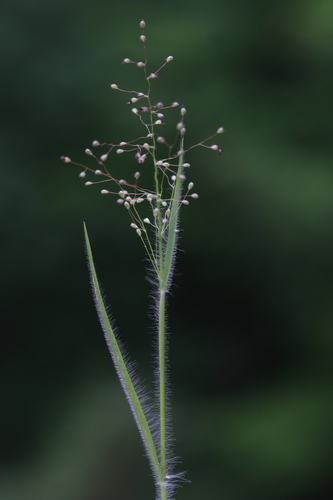
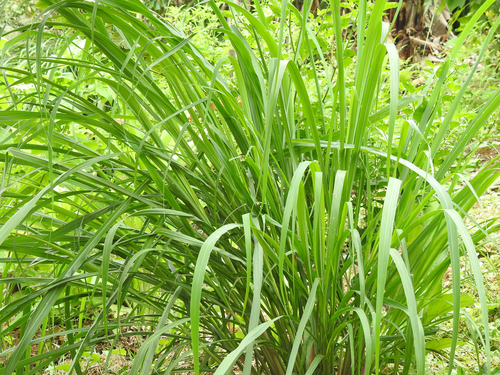
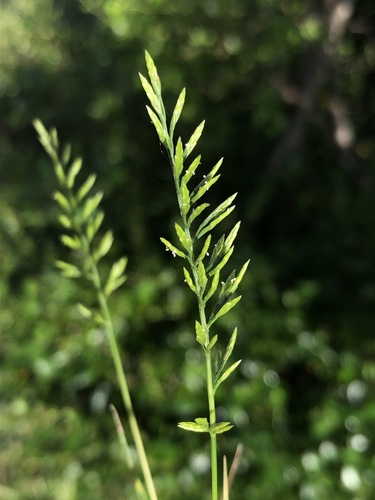
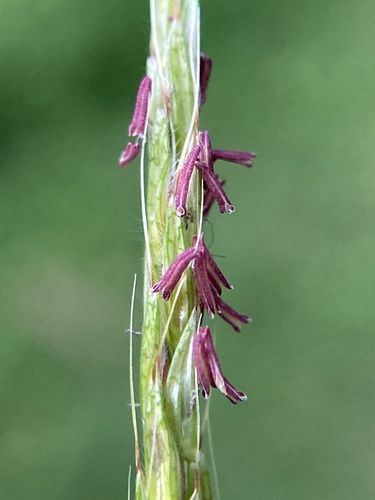
Microstegium vimineum, commonly known as Japanese stiltgrass, typically grows between 40 and 100 cm (1.3 to 3.3 ft) tall, and can root at each of its nodes. It flowers in late summer, and produces seeds in the form of a caryopsis soon after flowering. It closely resembles the North American grass Leersia virginica, and often grows alongside this species. It can be distinguished from L. virginica by the distinctive silver stripe running down the center of its leaf, a feature L. virginica lacks; L. virginica also flowers one to two months earlier than Japanese stiltgrass.
Microstegium vimineum is native across much of Asia, ranging from Turkey in the west to Japan in the east. Its native East Asian distribution includes China, Japan, the Russian Far East, North Korea, South Korea, and Taiwan. In Southeast Asia, its native range covers Malaysia, Myanmar, the Philippines, Thailand, Laos, and Vietnam. In South Asia, it occurs in Bhutan, India, and Nepal. In West Asia, specifically along the Caucasus, Black Sea, and Caspian Sea coasts, it can be found in Turkey, Georgia, Iran, and Sochi, Russia. This species has also been extensively introduced outside of its native range. In North America, it is established across the Midwestern, Southeastern, West South Central, and Northeastern United States, as well as southern Ontario, Canada.
Although it is considered invasive in the United States, stiltgrass does provide some benefits. It acts as a host plant for some native satyr butterflies, including the Carolina satyr Hermeuptychia sosybius and the endangered Mitchell's satyr Neonympha mitchellii. When no other suitable habitat is available, stiltgrass is preferable to bare ground, providing cover for native amphibians such as wood frogs and toads. Stiltgrass also creates unfavorable habitat for ticks: conditions here have higher temperatures and lower humidity, which increases tick mortality. Dead fallen stiltgrass stems provide shelter for rodents that protects them from aerial predators like owls and hawks. White-tailed deer do not eat stiltgrass, and they help it become dominant by feeding on its competing plants. However, stiltgrass can be outcompeted by other aggressive plant species, including annual ryegrass, Virginia cutgrass, and jewelweed. Stiltgrass can also be controlled by regular fires, thick leaf litter, and the natural succession of taller herbaceous plants.