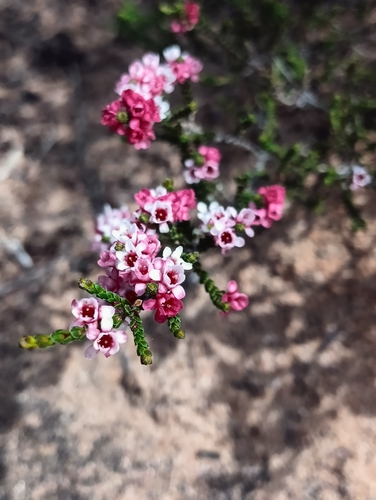
About Micromyrtus ciliata (Sm.) Druce
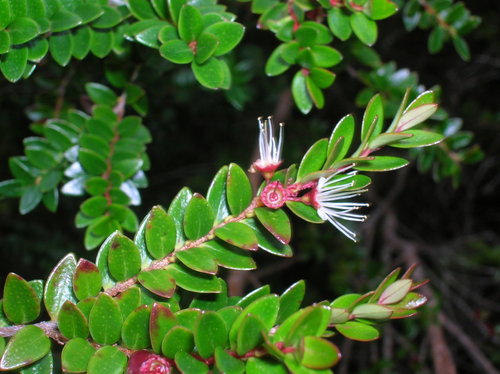
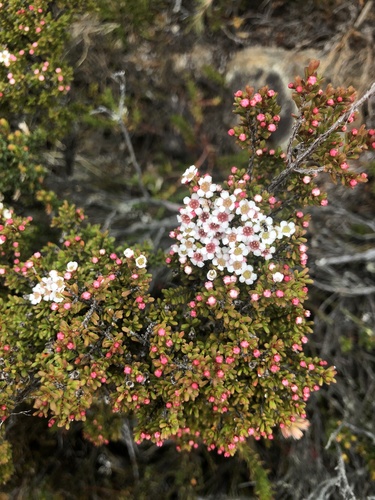
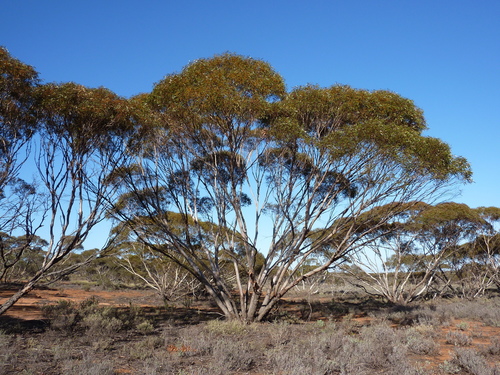
Micromyrtus blakelyi is a spreading to erect shrub that typically reaches 0.3 to 1.2 meters (1 foot 0 inch to 3 feet 11 inches) in height. Its leaves are crowded, oblong to egg-shaped with the narrower end oriented toward the base. The leaves measure 1.5 to 4.0 millimeters (0.059 to 0.157 inches) long and 0.5 to 1 millimeter (0.020 to 0.039 inches) wide, and are more or less sessile. The flowers are also more or less sessile, arranged singly in upper leaf axils, and form clusters near the ends of branches, with 2 to 5 millimeter (0.079 to 0.197 inch) long bracteoles at their base. The sepals are more or less round, up to 1 millimeter (0.039 inches) long. The petals are white or pink, broadly elliptic, 1.5 to 4 millimeters (0.059 to 0.157 inches) long and 1 to 2 millimeters (0.039 to 0.079 inches) wide. There are usually five stamens, with filaments 1.0 to 1.5 millimeters (0.039 to 0.059 inches) long. Flowering occurs mainly from August to December. Micromyrtus ciliata grows in a range of habitats including mallee, forest, and heath, often in rocky areas. It occurs in south-eastern and central New South Wales and the Australian Capital Territory, south from Merriwa and the Hunter region; in the drier parts of inland Victoria; and in the far south-east of South Australia.