About Micromeria douglasii Benth.
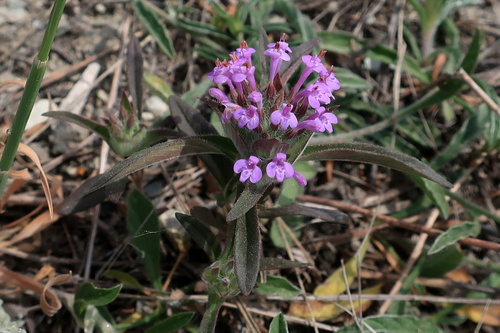
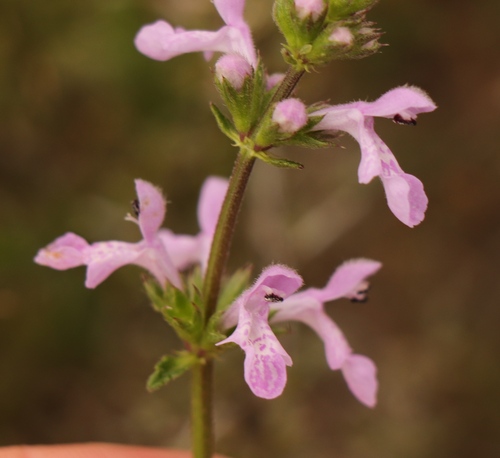
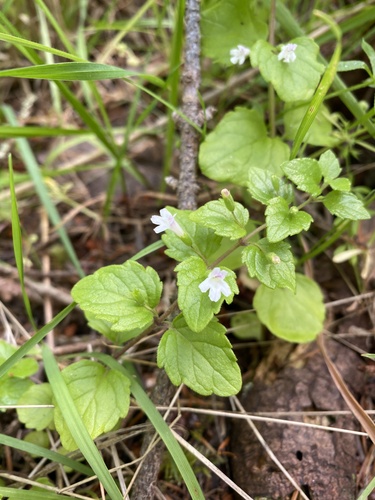
Clinopodium douglasii (also published under the scientific name Micromeria douglasii Benth.) is a decumbent perennial herb. Its leaves grow in opposite arrangements along the stem; each leaf has a petiole, is relatively small, and shaped ovate to nearly triangular, with shallowly toothed margins. Flowers grow at leaf axils, are solitary (or occasionally in clusters of 2 to 3) on short pedicels. Each flower has a tubular calyx that supports a lobed, bilaterally symmetrical labiate corolla characteristic of the mint family, which is white to lavender in color and typically 3 to 8 millimeters long. Inside the flower, under the upper lip of the corolla, are two fused styles ending in a two-lobed stigma, plus four exserted stamens arranged in two pairs. Its fruit is a tiny, smooth-surfaced nutlet. All parts of the plant are strongly aromatic, with a characteristic minty odor. This species is native to western North America, in the western United States and Canada, ranging from southern and eastern British Columbia down to southern California, and also grows in parts of the interior mountain ranges of the Pacific Northwest and northern California. The coastal and interior mountain populations of this species are largely disjunct, and the species is mostly absent from the dry interior regions between these two distribution areas, including the Interior and Columbia Plateaus, and California's Central Valley. The northern edge of the species' natural distribution lies in British Columbia, where it occurs on eastern and southern Vancouver Island, the Gulf Islands, and nearby mainland areas along the Salish Sea. In western Washington and Oregon, C. douglasii grows from the western side of the Cascade Range westward through the San Juan Islands, Puget Lowland, and Willamette Valley to the Olympic Mountains and Pacific Coast Ranges, though it is relatively less frequent near the Pacific coast. From southwestern Oregon southward into California, its distribution becomes gradually more coastal, ranging from the Pacific coast inland into the Klamath Mountains and California Coast Ranges. It is commonly found as far south as the Santa Monica Mountains and Santa Catalina Island. One single collection of C. douglasii has been reported from Juneau, Alaska, but this is thought to be an introduced population, and the species does not otherwise occur that far north. C. douglasii also grows in the moist western slopes of the interior mountains of the Pacific Northwest, including the Columbia Mountains, the westernmost subranges of the Rocky Mountains, and the Blue and Wallowa Mountains, ranging from the British Columbia Interior south to northeastern Oregon, and east as far as northern Idaho and western Montana. In California, it occurs occasionally on the western side of the northern Sierra Nevada. Throughout its range from Southern California to western British Columbia, this species was used by Indigenous groups as both a beverage and a medicine. The most widespread traditional use was as a mint-flavored beverage tea, a practice that was later adopted by non-native settlers. The herb was also used medicinally, most commonly to treat colds and fevers, abdominal pain and colic, and it was used as a traditional "blood purifier" and a remedy for kidney issues. Prepared as a strong decoction or infused in goat's milk, this plant (commonly called yerba buena) was used as an anthelmintic by the Rumsen, Mutsen Ohlone, and Chumash peoples, as well as by Mission Indians and Californios in California's Central Coast region. The Hoopa and Karuk peoples sometimes wore the plant's vines around their necks or in their hair as a fragrance, while Indigenous people of the Oregon coast used the aromatic plant to mask their scent while hunting.