About Microcitrus australis (Planch.) Swingle
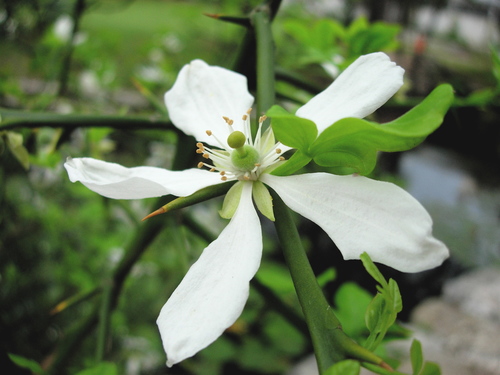
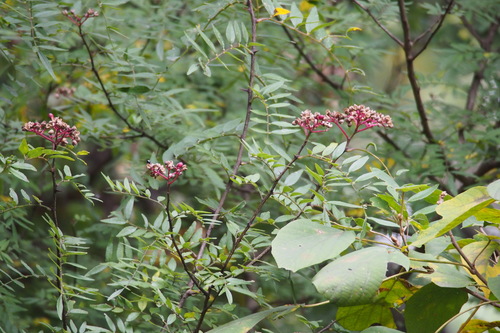
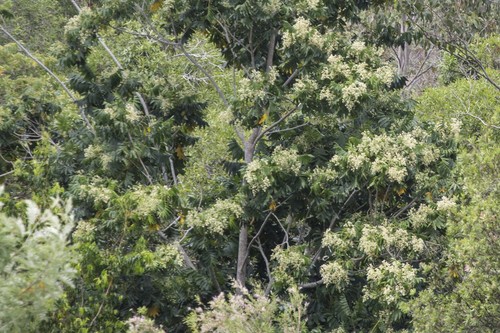
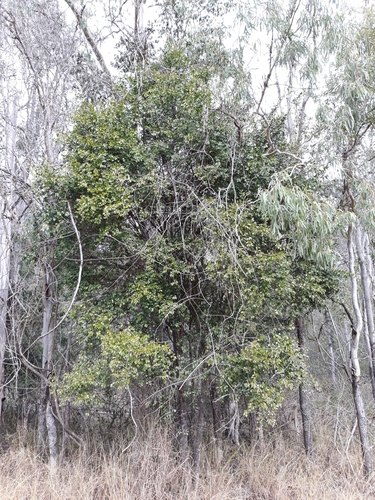
Microcitrus australis (Planch.) Swingle, also called Citrus australis, is commonly known as dooja, round lime, Australian lime, or Australian round lime. This plant is a large shrub or small tree in the wild, and can grow up to 20 m (66 ft) tall; when grown in gardens, it typically stays a small shrub or tree between 3 to 6 m (9.8 to 19.7 ft) high. Young plants have many protective thorns that become less numerous as the plant matures, making it easier to maintain. It grows naturally on forest margins from the Beenleigh area northwards in Queensland, Australia. Its fruits are spherical or slightly pear-shaped, 25–50 mm (0.98–1.97 in) across, with thick green or yellow skin and pale green pulp. When ripe from November to March, the fruit skin turns greenish-yellow, and flowering only occurs in spring. The 1889 book *The Useful Native Plants of Australia* records that the fruit, which is one and a half inches in diameter and almost globular, yields an agreeable beverage from its acid juice. Recorded nutritive properties per serving are: energy 91 g, moisture 74.8 g, protein 2.2 g, nitrogen 0.35 g, ash 0.8 g, dietary fibre 6.7 g, carbohydrates 15.5 g, Ca 46 mg, Cu 0.2 mg, Fe 0.5 mg, Mg 24 mg, K 270 mg, Na 4 mg, Zn 0.1 mg, niacin 0.37 mg. This species remains used in cooking in Australia today. The fruit is acidic and can be eaten raw, but it is more commonly used to make marmalades or as a lime flavouring. Peels can be cut to add an accent to pastas, or ground to integrate subtly into sauces, and the fruit pairs well with seafood. Oils secreted in the fruit vesicles can be used as an essential oil, thanks to their distinctive fragrant scent, and can also be included in cleaner sprays that rely on limonene, most commonly sourced from limes. Its close-grained wood, grown on volcanic soils, is suitable for cabinet making and engravings. Citrus australis is also used to create citrus hybrids. As a vigorous commonly occurring native Australian citrus species that is not resistant to viroid infection, it is an ideal target for research tracing the history of citrus species. One example hybrid is the Sydney hybrid, a cross between Citrus australis and Citrus australasica found primarily in Australia. This hybrid is also called Microcitrus x virgate H. Hume or Citrus x virgate Mabb. It resembles Citrus australasica in leaf size and fruit shape, with an elongated form measuring roughly 3 cm × 5 cm (1.2 in × 2.0 in) with a rounded apex, while Citrus australis has a more circular fruit shape; the Sydney hybrid is also known to be very drought-resistant. Citrus australis is most often compared to two other citrus types. The first is Citrus australasica, which grows in similar conditions in Southeast Queensland and northeast New South Wales, and is also used for juices and jams. Citrus australasica is more prized for use in preserves, while Citrus australis is more suitable for flavouring. The second comparison is to Tahitian lime, also called Persian lime, which is also used for marmalades and juices, but has rough skin so the entire fruit is not commonly used. Citrus australis has dryer flesh than Tahitian lime, but can be cut in half or used whole to flavour many dishes.