About Micrathene whitneyi (J.G.Cooper, 1861)
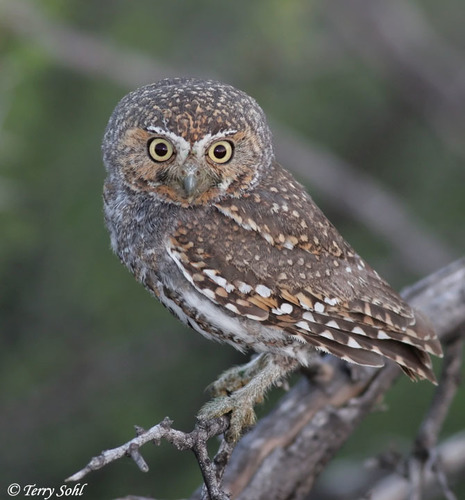
The elf owl (Micrathene whitneyi) is the world's smallest and lightest owl, though the long-whiskered owlet and Tamaulipas pygmy owl reach a similarly small body length. This species has an average body weight of 40 g (1.4 oz). Adult elf owls measure 12.5 to 14.5 cm (4.9 to 5.7 in) in total length, with a wingspan of approximately 27 cm (10.5 in). The projection of their primary flight feather extends nearly past their tail. They have fairly long legs that often give them a bow-legged appearance. Elf owls are commonly found in chaparral habitat, and are easily located during their breeding season. They are most active at dusk and just before dawn, when they can often be heard calling to one another with high-pitched whinny or chuckle vocalizations. These calls typically consist of 5 to 7 repeating short notes, similar to the sound of a young puppy. Elf owl vocalizations differ by sex: males have a wider range of complex notes compared to females. Males have two main song classes that share similar structural and functional characteristics. Class A songs, which most avian observers recognize, range in length from 5 to 15 notes, and are used both to claim territory and signal a male's arrival to nearby females. Class A songs change in response to environmental factors including wind, precipitation, moonlight, and temperature. In contrast, Class B songs show far less variation between individuals. Class B songs act as the primary mating call, stimulating females and encouraging them to accept a male's mating advances. As the breeding season progresses and mating occurs, Class A songs are heard less frequently than Class B songs. Both male and female elf owls also have a small set of additional locational, scolding, and territorial calls. Elf owls are migratory, with migration patterns varying by flock and habitat location. Some breeding groups migrate to the southwestern United States (California, Arizona, New Mexico, and Texas) during spring and summer to breed. In winter, these migratory individuals are found in central and southern Mexico. Migrant elf owls return to northern breeding grounds between mid-April and early May. Permanent non-migratory populations exist in a few locations in south-central Mexico and along the Baja California peninsula. When handled, elf owls feign death, an adaptation that encourages predators to loosen their grip, allowing the owl to escape. Elf owls are strongly territorial. Males establish territories, which both the male and female defend; males also treat their selected female mate as a territory to defend. Defense of territories and mates is most often done through song. During the breeding season, elf owls are monogamous and remain in breeding pairs, but they gather in small groups during migration and when mobbing predators. Both adult and young elf owls may be preyed on by other predatory birds including jays, hawks, and other owls. Elf owls hunt mostly during nocturnal hours. They typically fly in straight lines while hunting, but use arced flight when near their nest and when traveling to and from perches. They roost and nest in cacti, taking advantage of the shade and favorable microclimate cacti provide. Elf owls feed mainly on arthropods, including moths, crickets, scorpions, centipedes, and beetles. Agaves and ocotillos are ideal foraging sites, as their flowers attract moths and other insects. In urban areas, elf owls hunt around outdoor lights that draw in insect prey. They often chase flying insects in a flight pattern similar to that of tyrant flycatchers. They regularly feed on scorpions: after killing a scorpion, the owl removes the stinger before eating it, and they appear to be unaffected by scorpion stings. Occasionally, elf owls also prey on small mammals such as kangaroo rats, reptiles including spiny lizards, earless lizards, and blind snakes, and other small birds.