About Micrathena horrida (Taczanowski, 1873)
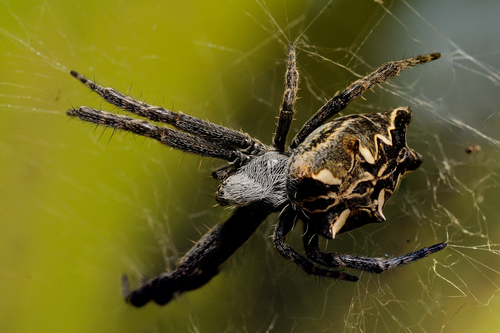
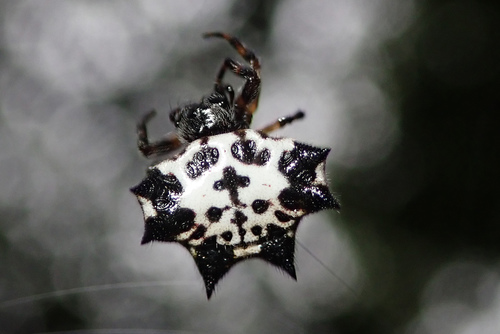
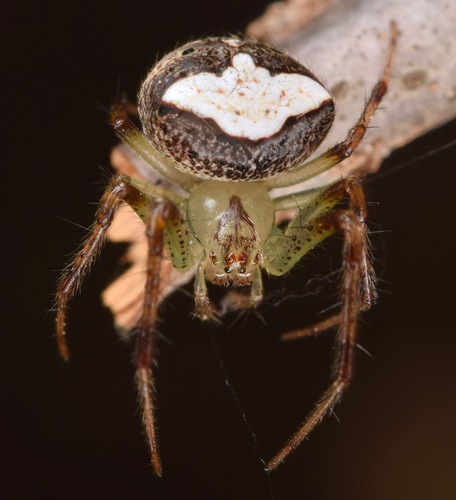
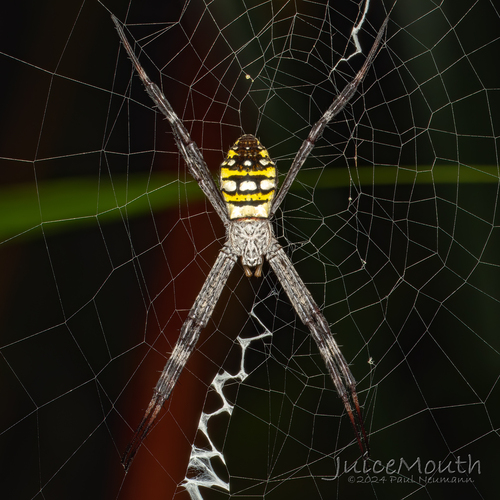
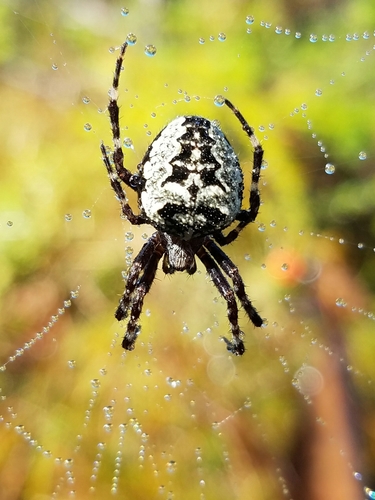
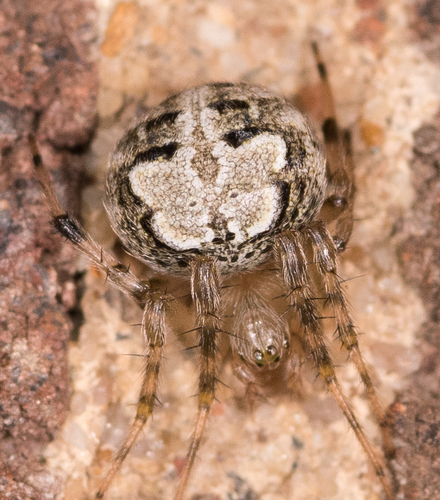
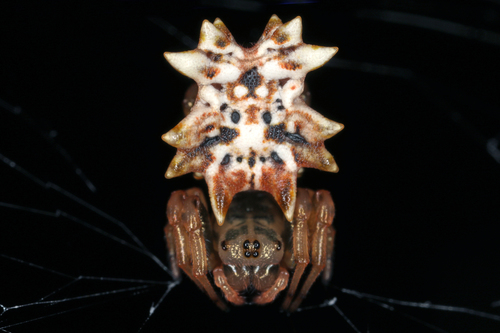
This spider species is formally known as Micrathena horrida (Taczanowski, 1873). Females of this species measure 7.0 to 11.5 mm in total body length, while males are smaller, ranging from 4.5 to 5.0 mm in length. Females have an orange-brown carapace that has darker brown sclerotized areas, plus dark gray markings above its rim. Their sternum and legs are orange-brown, and their abdomen ranges from gray to orange with black markings. The abdomen of females typically has twelve or more prominent humps, also called tubercles; this trait distinguishes M. horrida from related species such as M. gracilis, which only has ten humps. Female abdomens can sometimes be slender with humps, or have a tail-like extension, and the carapace may sometimes have dimples. Some individual spiders have a prominent pattern of black patches on a white background on the upper surface of the abdomen. Males have a brown carapace, a grayish brown sternum, and lighter brown legs. The male abdomen is brown, with white patches along its margin and some gray and black pigment on its upper surface. A distinct trait of males is their segmented posterior abdomen, and males can also be identified by specific features of their palpus: specifically, their paracymbium has a keel that runs almost parallel to the axis of the cymbium. M. horrida has been recorded from the Greater Antilles (Cuba and Jamaica), and ranges from Mexico south through Central America (including Belize, Guatemala, Honduras, El Salvador, Nicaragua, Costa Rica, and Panama) to Argentina, across most of South America (including Colombia, Venezuela, Guyana, Suriname, French Guiana, Brazil, Ecuador, Peru, Bolivia, Paraguay, and Argentina). Across its entire range, M. horrida occurs in forest habitats.