About Micranthes stellaris (L.) Galasso, Banfi & Soldano
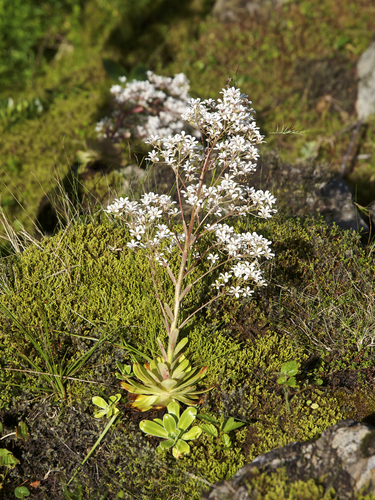
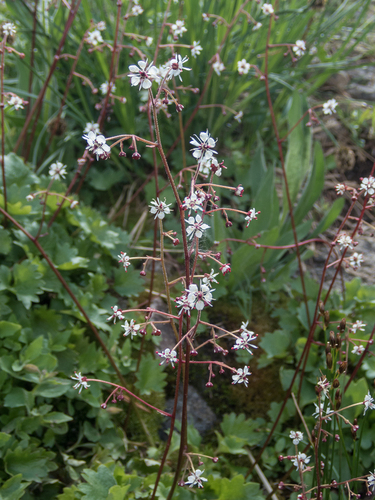
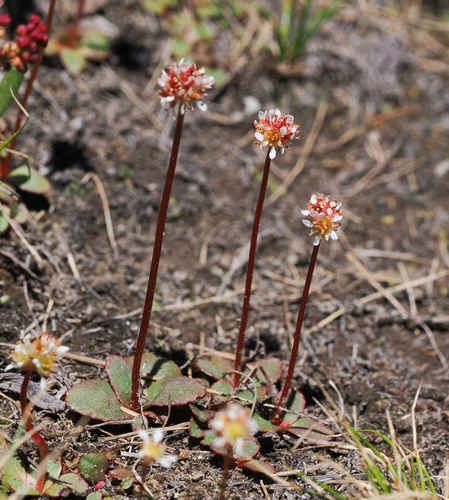
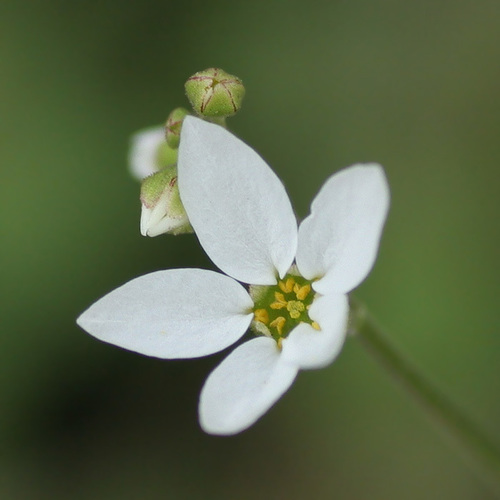
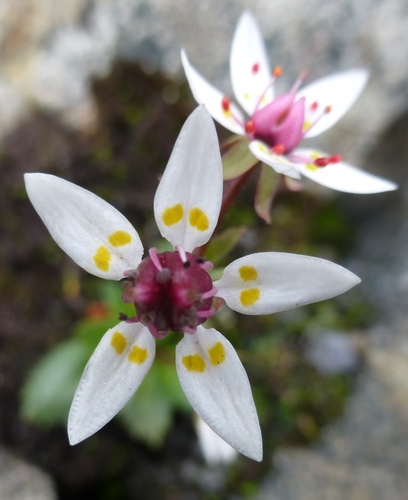
Micranthes stellaris grows as a leaf rosette, from which a generally leafless stem grows up to 20 centimetres (7.9 in) tall. Its leaves are toothed, somewhat fleshy, ovate or obovate, and lack an obvious petiole. They typically measure 3 cm (1.2 in) long, ranging between 1 and 5 centimetres (0.4 to 2.0 inches), and have a cuneate (wedge-shaped) base. Flowers grow in a loose panicle that holds 5–10 flowers. Each flower has deflexed sepals surrounding five white petals that are 3–6 millimetres (0.12–0.24 in) long, with two yellow or red spots near their base. This species has 10 stamens, with anthers that are also red or yellow. Flowering occurs from June to August. The seeds of Micranthes stellaris are dark brown, glabrous, 0.6–0.8 mm (0.024–0.031 in) long, and 0.3–0.4 mm (0.012–0.016 in) wide. They are elliptic, ovoid or reniform in shape, with longitudinal ribs that bear spines. The chromosome number of M. stellaris is 2n = 28. Micranthes stellaris has an Arctic–alpine distribution. It occurs from Baffin Island, Labrador and Greenland to Arctic Russia, and can also be found in Iceland, Scandinavia and the British Isles. Further south, it ranges from the Sierra Nevada in southern Spain to the eastern Carpathians, including lower ranges such as the Massif Central. In the Arctic, M. stellaris may grow down to sea level. Within the British Isles, M. stellaris is abundant in North Wales, Northern England and Scotland, reaching the summit of Ben Nevis (1,344 m or 4,409 ft), but is only found locally in Ireland. Its southernmost growing sites in Great Britain are the slopes of Plynlimon and the Rheidol valley, and it does not grow in the mountains of South Wales. In the Vosges, it occurs around 3,600 ft (1,100 m), but it is rarely found below 4,300–4,600 ft (1,300–1,400 m) in the Swiss Alps. In the Sierra Nevada of southern Spain, it grows at up to 3,350 m (10,990 ft). Micranthes stellaris inhabits damp environments, including wet flushes, areas beside streams or springs, and wet rock ledges. It is self-compatible, but its flowers are protandrous, and they are usually pollinated by flies.