About Metrosideros umbellata Cav.
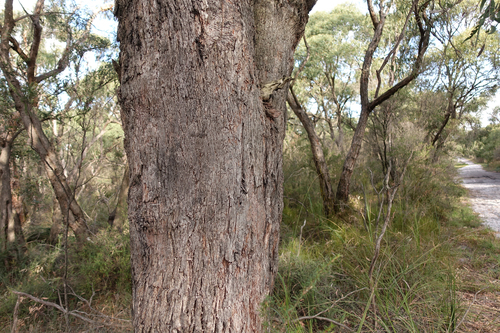
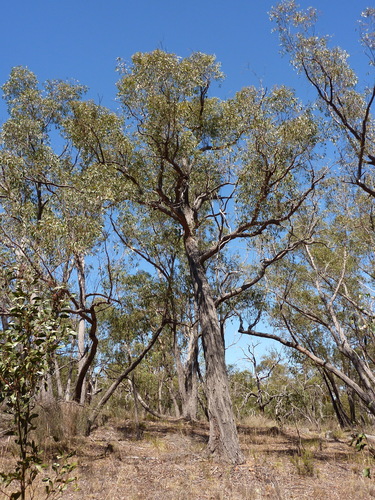
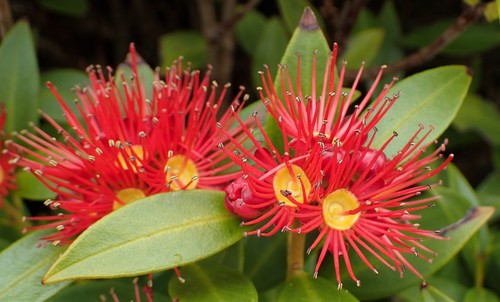
Metrosideros umbellata, commonly called southern rātā, is an evergreen tree in the family Myrtaceae that is endemic to New Zealand. It can grow up to 15 metres (50 feet) tall, with a trunk up to 1 metre (3 feet 3 inches) in diameter, and is estimated to live between 400 and 500 years. Its bark is 2 to 3 millimetres thick, and outer bark layers peel away as papery flakes. Its flower clusters (inflorescences) grow as an axillary pair next to an aborted stem; each inflorescence holds 1 to 3 pairs of small-flowered cymules that each bear 1 to 3 flowers. The peduncles can reach up to 10 centimetres (3.9 inches) long. The receptacles, specialized vegetative tissues, are obconic (inverted cone-shaped) and gradually become smooth. Sepals are oblong-triangular, ovate, or bell-shaped (campanulate) and roughly 3 millimetres long. Petals (corollas) are red, thick, concave (curved inward), oval, thin, and around 5 millimetres long. Leaves of M. umbellata measure 2.5 to 6 centimetres (1 to 2 inches) long and 1 to 2 centimetres (0.4 to 0.8 inches) wide, gradually narrowing to a sharp tip and a short stalk. Leaves are nearly stalkless (subsessile), lanceolate-shaped, and taper to a point (acuminate) on both ends. They are dark green, leather-like (coriaceous), smooth (glabrous), and dotted with many small oil glands. Beneath the outer leaf epidermis, M. umbellata has a layer of water-filled cells with densely packed chlorophyll-containing granules; chlorophyll is the pigment that absorbs sunlight. It is thought this structure may have evolved to adapt to colder climates. Flowering in M. umbellata is unpredictable, with intensity varying between individual trees and locations. It typically flowers during the New Zealand summer, from November to March, and flowering occurs later at higher altitudes. While flower colour most commonly ranges from crimson to red, pink flowers also occur. Stamens, the pollen-producing parts, are 2 centimetres (0.79 inches) long and usually red. The seed capsules are woody and around 8 to 9 millimetres (0.31 to 0.35 inches) long. The roots of M. umbellata are very small (around 0.2 millimetres in diameter) and highly branched. This trait is likely caused by the short lifespan of most root tips, which are regularly replaced by new lateral rootlets growing from older sections of the root system. After around 100 years of growth, trees develop aerial roots in humid locations. These roots may either hang freely or grow downward from the trunk; once their tips enter the ground, they begin increasing in diameter, and eventually grow together and intermingle with the central trunk. M. umbellata has a diploid chromosome count of 22. M. umbellata is endemic to New Zealand. Most of its range covers the South Island and Stewart Island, with small local populations also present in the North Island and the subantarctic Auckland Islands. Its northernmost natural population is at Te Paki in the Northland Region, and its southernmost natural population is in the subantarctic Auckland Islands, a group of extinct volcanoes that were once part of the now mostly submerged continent of Zealandia. M. umbellata forms a coastal barrier on Stewart Island and some of its offshore islands, as well as along the coast of the Southland Region. Its range extends inland from Southland to the Hokonui Hills, but it is rare or naturally absent from ranges north of the Hokonui Hills. The species is more common west of the Southern Alps, and is abundant in the West Coast Region; populations grow in nearly every fiord and reach almost subalpine altitude at the Franz Josef and Fox Glaciers. East of the Southern Alps, M. umbellata populations are uncommon and widely scattered. Individual trees also form small populations on the shores of lakes including Coleridge, Sumner and Wakatipu, within Aoraki / Mount Cook National Park, in the Marlborough Sounds, and at the mouth of the Taieri River. Small populations also grow at the foothills of the Southern Alps in the Canterbury Region, and near the small settlement of Glentui, close to the town of Oxford. In the North Island, M. umbellata is extremely rare, with scattered populations on Great Barrier Island and Little Barrier Island, the Coromandel Range, a forest near Te Aroha, and a very small number of individuals in the Tararua Ranges. M. umbellata typically grows in coastal to montane environments, and is commonly found on banks, within forests, scrub, and shrubland, on slopes, and in rocky areas. Its altitudinal range varies by location. In the North Island, it occurs between 600 and 720 metres (1,970 to 2,360 feet) above sea level on Little Barrier Island and in the Coromandel Ranges, and between 550 and 600 metres (1,800 to 1,970 feet) in the Tararua Ranges. In the South Island, it occurs across a wider range of altitudes, growing as low as sea level. Its upper altitudinal limit in Westland is around 800 metres (2,600 feet) above sea level, but it can grow above 1,100 metres on some north-facing bluffs. M. umbellata can grow on rock (it is rupestral), and its habitat is described as unrestricted: it grows on a range of substrates and hard surfaces, in coastal sand dunes, and sometimes overhangs water on sheltered coasts. In the Canterbury Region, some specimens have been recorded with snow damage; branches in particular may be fragile and snap under heavy snow. Despite this, heavy snowfall does not have a lasting effect on the species' distribution. In the Westland District, M. umbellata has been observed growing on large boulders, logs, and sometimes as an epiphyte (growing on another plant) on living trees. The seeds of M. umbellata are very small, weighing less than 0.1 milligrams, making them well adapted to wind dispersal. Seedlings have been found up to 270 metres (890 feet) from the nearest mature seed-producing tree, and it is likely seeds can travel even longer distances. The nectar-rich flowers are pollinated by and visited by many native New Zealand birds, including tūī (Prosthemadera novaeseelandiae) and bellbirds (Anthornis melanura). In The Catlins, the southeastern corner of New Zealand, the species is so often visited by kākā (Nestor meridionalis) that the locality Kaka Point is named for being a favoured spot for kākā to feed on M. umbellata. In the Southern Alps, the mountain parrot kea (Nestor notabilis) is regularly seen perching on M. umbellata flowers. Flowers are also visited by introduced honeybees (Apis mellifera). M. umbellata is frequently browsed by introduced deer, pigs, cattle, goats, and to a lesser degree, wallabies. It acts as a host plant for three species of endemic New Zealand longhorn beetles: Blosyropus spinosus, Didymocantha, and Prionoplus reticularis. Several moths also use M. umbellata as a host, including Pyrgotis plagiatana, Planotortrix excessana, and two species from the genera Declana and Selidosema.