About Metrosideros robusta A.Cunn.
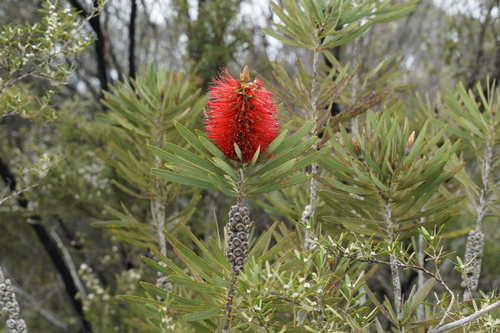
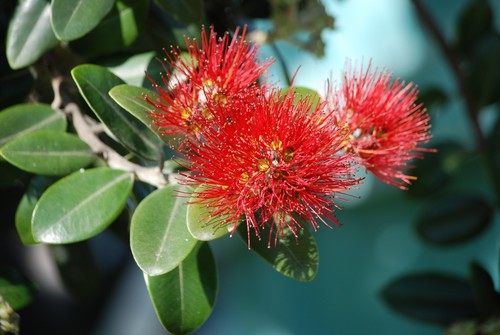
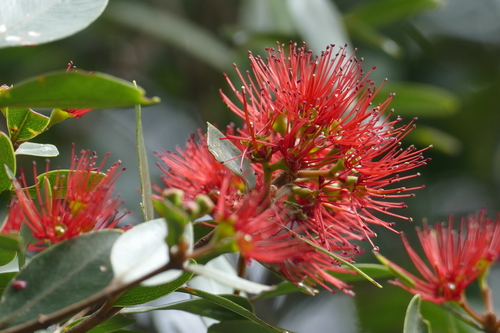
Northern rātā, with the scientific name Metrosideros robusta A.Cunn., is a massive tree. It can be easily distinguished from other Metrosideros species by its small, leathery, dark green leaves. These leaves measure 2–4 cm (0.79–1.57 in) long, and have a distinct notch at the tip. Young growth is generally pink, and covered in fine rust-coloured hairs. These hairs are gradually shed as the foliage ages, but tend to remain on the leaf midrib and near the leaf base. The flowers, which grow in sprays at the tips of branches, consist of a mass of dark scarlet stamens. Flowering peaks between November and January, and seeds take one year or slightly more to ripen. The bark is usually brown or grey-brown and rather corky, and creates an ideal layer for the roots of epiphytic plants such as Astelia species and Freycinetia banksii (kiekie). The wood is reddish brown, and its growth pattern produces a twisted grain. Northern rātā is found in the North Island of New Zealand from Te Paki in the north to Wellington in the south. It was formerly widespread across this range, but is now uncommon across large parts of its former distribution, and is apparently only present in the south-east of Hawke's Bay, being absent from the rest of the region. In the South Island, northern rātā is common from Nelson to Greymouth and Hokitika. It reaches its southern limit near Lake Mahinapua, at 42°4′ South latitude. Its natural habitat is forest along coasts and in the lowlands. In some parts of its range, northern rātā grows in montane forest. Formerly, together with rimu (Dacrydium cupressinum), it was a dominant tree species in a forest type known as rimu/rātā forest. In 2024, an unusual 32-meter (105 feet) tall northern rātā near Karamea on the west coast of the South Island won the New Zealand Arboricultural Association (NZ Arb)'s Tree of the Year Award with 42% of the public vote. This tree is nicknamed the "walking tree" because it has a pair of leg-like trunks that look like legs walking across a field. Northern rātā can be propagated easily from fresh seed. The seed's viability drops quickly after a few weeks, or if it is allowed to dry out. Cuttings do not root easily, but better results can be achieved when using water shoots. At least three cultivars of northern rātā have been released. Cultivars are also known from hybrids between northern rātā and pōhutukawa, a hybrid cross named Metrosideros ×sub-tomentosa, as well as hybrids between northern rātā and southern rātā. Known cultivars include hybrids of northern rātā and southern rātā, and hybrids of northern rātā and pōhutukawa.