About Metrosideros polymorpha Gaudich.
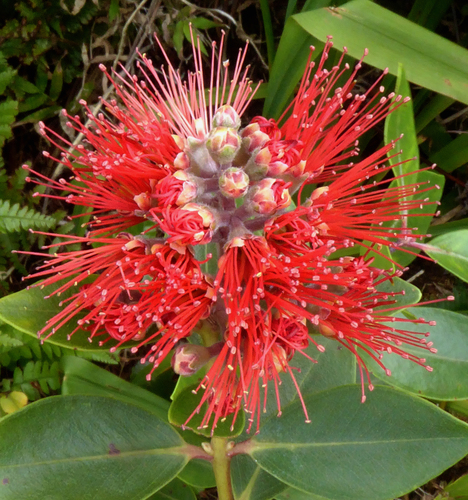
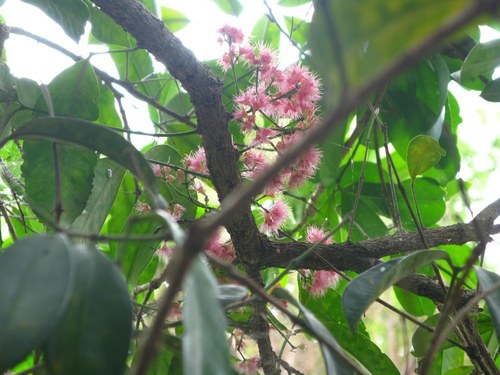
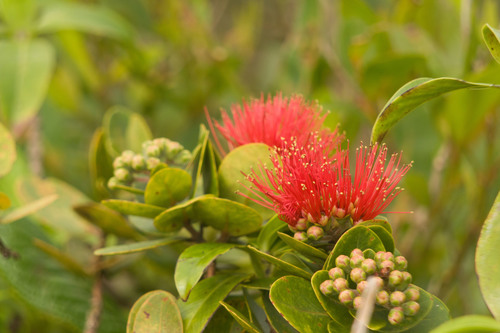
Metrosideros polymorpha Gaudich. is a relatively slow-growing plant that can take the form of a prostrate shrub, a tall tree, or any growth habit in between. It can reach up to 30 m (98 ft) in maximum height. Its trunk varies in form: some individuals have straight, smooth trunks, while others have twisted, prominently fluted trunks. Flower color is most often bright to medium red, though forms with orange-red, salmon, pink, yellow, or orange flowers also exist. Flowers grow in clusters at the terminal ends of branches. Masses of stamens extend out from each flower, giving the blossoms a distinct pom-pom shape. The stomata on this species' leaves can close when exposed to harmful gases, giving it an advantage over many non-native tree species. This species is the most common native tree in the Hawaiian Islands, and it tolerates a very wide range of soil conditions, temperatures, and rainfall amounts. It grows from sea level all the way up to the tree line at 2,500 m (8,200 ft) in elevation. It is commonly found in moist and dry forests, as well as high shrublands, and it acts as a colonizer of new lava flows. It is dominant in cloud forests above 400 m (1,300 ft), and is also common in seasonally wet forests, where it may be the dominant species or grow in mixed stands with the native tree Acacia koa. It prefers acidic to neutral soils, with a pH range of 3.6–7.4, and can grow in Histosol, Mollisol, Podsol, Oxisol, Ultisol, or Alfisol soil types. It favors annual rainfall of 1,000–3,000 mm (39–118 in), but can grow in dry forests receiving as little as 400 mm (16 in) of rain annually, or in bogs receiving more than 10,000 mm (390 in) of rain per year. When growing in moist, deep soils, M. polymorpha reaches heights of 20–25 m (66–82 ft). Trees growing in forests often develop stilt roots, because they germinate on fallen logs or the stems of hāpuʻu (Cibotium tree ferns), which fully decay long before the tree reaches maturity. Some individuals develop fibrous aerial roots to collect moisture. At high elevations, and in areas with poor soils or low rainfall, shrub growth forms are most common. The reddish brown heartwood of M. polymorpha is very hard, fine-textured, and has a specific gravity of 0.7. In traditional Native Hawaiian society, this wood was used to build houses and heiau (religious sites), and to carve papa kuʻi ʻai (poi boards), weapons, tool handles, hohoa (round kapa beaters), and kiʻi (statues and idols). While the trunk of ʻōhiʻa is not used to make the kaʻele (hull) of waʻa (outrigger canoes), it was used to make the canoes' nohona waʻa (seats), pale (gunwales), and pola (decking). Wae (spreaders) were carved from the curved stilt roots of ʻōhiʻa. Wood from this species was used to make pā (fencing) because it was readily available; kauila wood (from Colubrina oppositifolia or Alphitonia ponderosa), which is more durable when in contact with soil, was much rarer. Because this wood burns hot and clean, it is excellent wahie (firewood). The lehua (flowers) and liko lehua (leaf buds) of this species are used to make lei. The flowers were used medicinally to treat pain experienced during childbirth. ʻŌhiʻa lehua is one of the few honey-producing plant species native to the Hawaiian Islands.