About Metrosideros excelsa Sol. ex Gaertn.
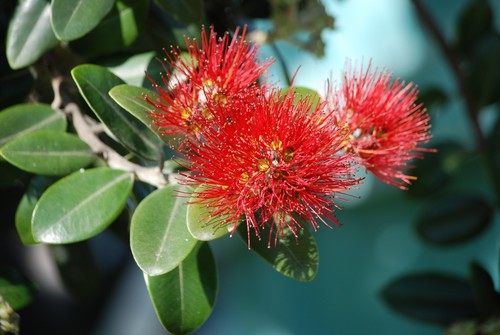
Scientific name: Metrosideros excelsa Sol. ex Gaertn. Description. Pōhutukawa reach up to 25 metres (82 ft) tall, with a spreading, dome-shaped growth habit. They typically grow as a spreading multi-trunked tree. Their trunks and branches sometimes hold dense mats of fibrous aerial roots. Their oblong, leathery leaves have a covering of dense white hairs on the underside. This tree flowers from November to January, peaking in early summer between mid and late December, when brilliant crimson flowers cover the entire tree; this gives it the common nickname New Zealand Christmas tree. The first published mention of pōhutukawa being called a Christmas tree appeared in 1857, in a newspaper report of a feast hosted by Eruera Patuone. Individual trees vary in the timing of flowering, as well as the shade and brightness of their flowers. Genetic drift in isolated populations has created local genetic variation: many trees growing around the Rotorua lakes produce pink-shaded flowers, and the yellow-flowered cultivar 'Aurea' descends from a pair of yellow-flowered trees discovered in 1940 on Mōtītī Island in the Bay of Plenty. Distribution. The natural range of pōhutukawa is the coastal regions of New Zealand's North Island, north of a line stretching from New Plymouth (39° S) to Gisborne (38° S), where the species once formed a continuous coastal fringe. By the 1990s, pastoral farming and introduced pests had reduced the total area of pōhutukawa forests by over 90%. It also occurs naturally on the shores of Rotorua area lakes and in Abel Tasman National Park at the northern tip of the South Island. This tree is well known for growing on cliffs, able to anchor itself in precarious, near-vertical positions. Like its Hawaiian relative ʻōhiʻa lehua (M. polymorpha), pōhutukawa has been found to be very effective at colonizing lava plains — this is most notable on Rangitoto, a volcanic island in the Hauraki Gulf. Uses. Pōhutukawa wood is dense, strong, and has a striking figured grain. Māori traditionally used this wood for beaters and other small, heavy items. It was commonly used in shipbuilding, because its naturally curved growth forms produced strong structural knees for ships. Extracts from the tree's inner bark are used in rongoā, Māori traditional healing, to treat diarrhoea and dysentery, and the nectar is used to treat sore throats. Pōhutukawa nectar is used to produce pōhutukawa honey, which is made in areas including Rangitoto Island. Cultivation. Pōhutukawa is a popular cultivated tree, and fine mature specimens can be found in most North Island coastal cities. Vigorous and easy to grow, the tree thrives even well south of its natural range, and has become naturalised in the Wellington area and in the northern South Island of New Zealand. It has also naturalised on Norfolk Island, to the north of New Zealand. Pōhutukawa has been introduced to other countries with mild to warm climates. In south-eastern Australia, it has begun naturalising on coastal cliffs near Sydney. In coastal California, it is a popular street and lawn tree, but it has caused concern in San Francisco, where its root systems are blamed for damaging sewer lines and sidewalks. In parts of South Africa, pōhutukawa grows so successfully that it is considered an invasive species. The Spanish city of A Coruña has adopted pōhutukawa as its floral emblem. At least 39 cultivars of pōhutukawa have been released to gardeners. Duncan & Davies nurseries were a leading developer of cultivars in the mid-20th century, while the late Graeme Platt has bred 16 distinct cultivars to date, including a rare white-flowering tree.