About Metepeira labyrinthea (Hentz, 1847)
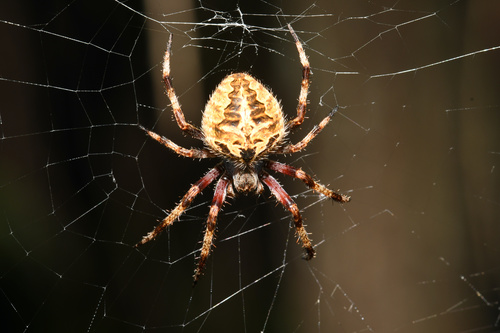
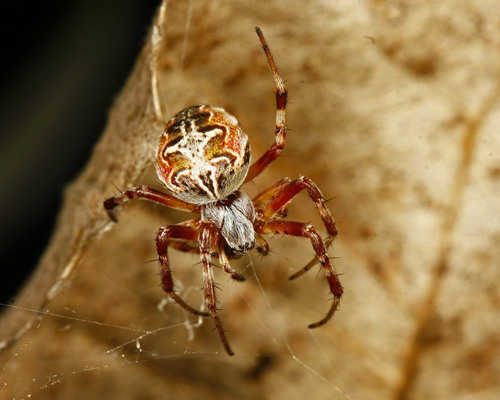
Metepeira labyrinthea, commonly known as the labyrinth orbweaver, is a spider species with thin legs and a round, bulbous abdomen. It belongs to the genus Metepeira within the family Araneidae. Adult females measure 5.3 mm in total body length, with a 2.3 mm carapace, 3.3 mm abdomen, and an extended leg span of 18.4 mm. The carapace is brown or gray, while the abdomen is dark with a distinct white pattern. The legs show alternating bands of pale brown and dark brown, and the sternum is dark brown with a longitudinal yellow marking. Males are three-quarters the length of females, or slightly larger, and have a darker carapace with greater contrast between the dark and light areas of the legs. Members of the genus Metepeira can be easily distinguished from other Araneidae by their light-colored eye region, white median line on the sternum, relative length of leg segments, small male palpus, weakly sclerotized epigyne, and distinctive composite web. The labyrinth orbweaver occurs across most of the United States, ranging south through the Neotropics to Argentina. It is locally common in open woodland and woodland edge habitats, where webs are typically built 3 to 8 feet above the ground. Orange trees, which have many dead bare lower branches, offer suitable sites for webs within their thorny twig clusters. This species is somewhat colonial, with many individuals living in the same tree, and their webs sometimes placed only a few inches apart. Webs of the labyrinth orbweaver are visible and the spider is active from March through October. During the rainy season, females mate and lay eggs. A female usually produces 5 or 6 egg sacs, holding an average of 55 eggs each. She deposits eggs into several silken discs strung together in a bead-like row, then builds an egg case around the cluster and hangs it in her web near her retreat, where it is camouflaged by other debris in the web. Once spiderlings emerge, they are self-sufficient and leave the mother's nest via ballooning. Like many other spiders, the labyrinth orbweaver is a predator that uses the orb portion of its web to capture prey, acting as a passive hunter that relies on the web to catch prey. One or more trap lines extend from the spider's retreat to the orb section of the web. The sticky spiraled prey capture threads of the orb web are critical to its function: they retain insects that strike the web, giving the spider time to locate captured prey. When an insect becomes entangled, the spider climbs down from the trap line to reach it and wraps it in silk within the web. If the spider needs food immediately, the insect is taken back to the retreat, where the spider eats its soft tissues and discards the remaining body parts from the web. In June 1980, a field experiment was conducted at the Patuxent Wildlife Research Center in Prince George's County, Maryland, to test whether food is a limiting resource for adult female Metepeira labyrinthea. Spiders built webs after being placed in open experimental units: half the units were left with natural prey densities, while spiders in the other units were given extra laboratory-reared flies to increase prey availability. Feeding treatments continued for 2.5 months, after which all egg sacs were collected from the units. Adding extra prey did not increase the spiders' survival rate, but the species did respond to increased prey availability by significantly increasing the number of eggs produced per female. Median egg production per female increased from 65 to 145 for M. labyrinthea, indicating that food is a limited resource for this species.