About Merops philippinus Linnaeus, 1767
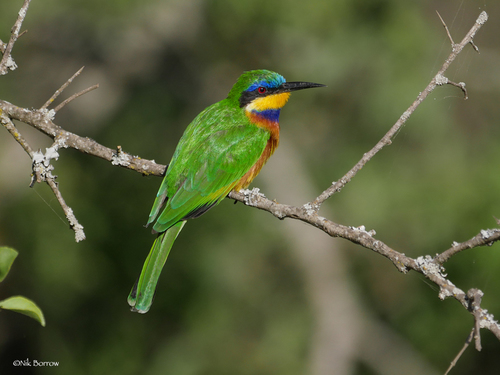
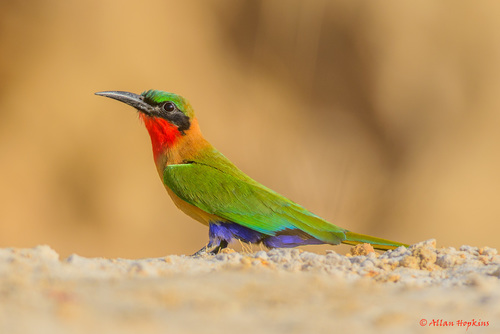
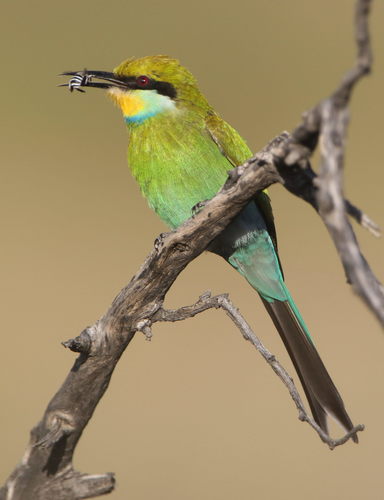
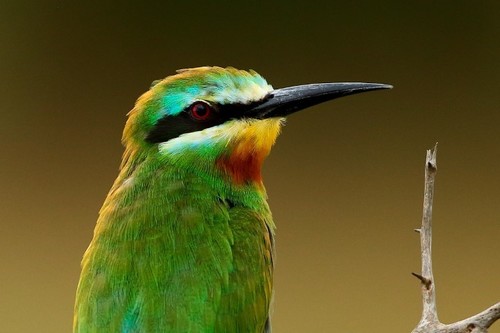
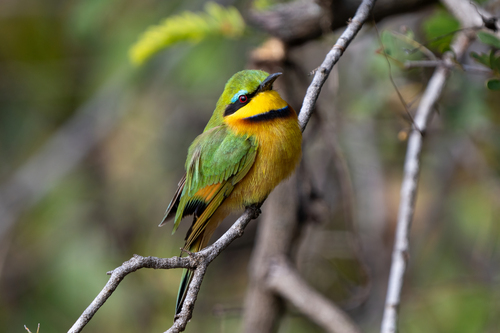
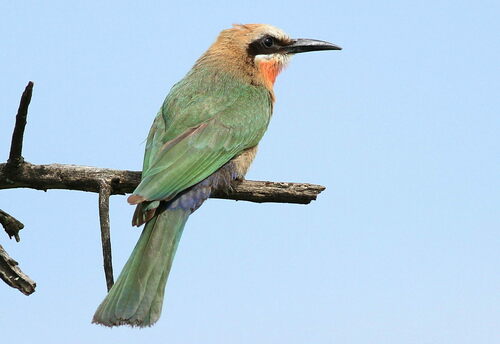
Like other bee-eaters, Merops philippinus (the blue-tailed bee-eater) is a richly colored, slender bird. Its plumage is predominantly green; its face has a narrow blue patch paired with a black eye stripe, and a yellow and brown throat. The tail is blue and the beak is black. Its three outer toes are connected at their bases. Excluding elongated central tail feathers, the species is around 29 cm long; these elongated feathers add an extra 7 cm to the total length. The birds weigh between 29 and 43 grams. Males and females look alike to the naked eye, though males generally have longer central tail feather extensions; UV reflectance studies have found that healthy males have darker chestnut throats and brighter green body plumage, while females have brighter blue rumps and brighter yellow chins. Juveniles are duller in color and lack the elongated central tail feathers that adults have. This species is most often found near water. Like other bee-eaters, it feeds primarily on flying insects, especially bees (as large as those in the Xylocopa genus), wasps, and hornets. It catches these insects in midair by launching flights from an open perch. It may also forage while flying over estuaries, backwaters, and even the sea, but it does not forage far from the coast. This species likely consumes bees and dragonflies in roughly equal amounts. After catching an insect, the bird beats it against the perch to kill it and break its exoskeleton, a habit shared by many other members of the order Coraciiformes. Its call, produced mostly during flight, is a rolling, chirping, whistling teerp. Within its range, the only species it can easily be confused with is the blue-cheeked bee-eater, which typically occupies drier habitats. Blue-tailed bee-eaters differ from blue-cheeked bee-eaters by having blue rumps and tails instead of green and black rumps and tails; their undertail feathers are bluish rather than green, their blue cheek patch is much smaller, and the chestnut coloring on their throat and breast is darker and covers a larger area. In India, this species breeds between April and May. It nests colonially, digging closely spaced nest holes into vertical mudbanks, and will also burrow into gently sloping land. It prefers to nest in sandy or sandy clay loam soils, and avoids heavier clay loams. It also favors clear mudbanks that have no vegetation cover. In Sri Lanka, blue-tailed bee-eaters have been recorded breeding in artificial sand dunes created by dredging sea sand. The nest tunnel can reach nearly 2 meters in depth. Females lay 5 to 7 nearly spherical eggs per clutch. Both the male and female incubate the eggs. Parent birds guard the nest to prevent intraspecific brood parasitism and extra-pair copulation. One or two helper birds may join the breeding pair after incubation begins. These birds feed and roost communally. This species has a patchy breeding distribution across India, Myanmar, and parts of Southeast Asia. In India, breeding populations are known from multiple river valleys, including those of the Godavari, Kaveri, Tunga Badra, and Krishna rivers. It also breeds in the eastern parts of Sri Lanka. Blue-tailed bee-eaters are seasonal visitors across much of their range, and they are known to migrate during the day in large groups at sites such as Tanjung Tuan in West Malaysia and Promsri Hill in southern Thailand. They are winter visitors to parts of Malaysia and peninsular India. The non-breeding ranges of blue-tailed bee-eaters and blue-cheeked bee-eaters overlap in parts of Gujarat and western peninsular India.