About Meripilus giganteus (Pers.) P.Karst.
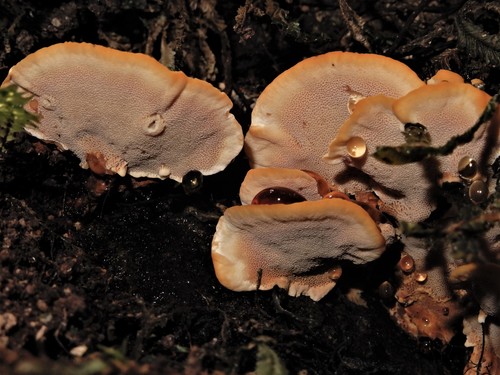
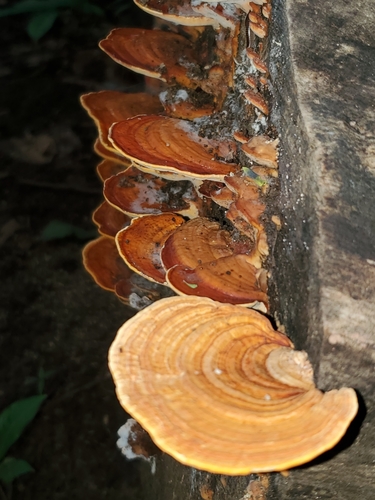
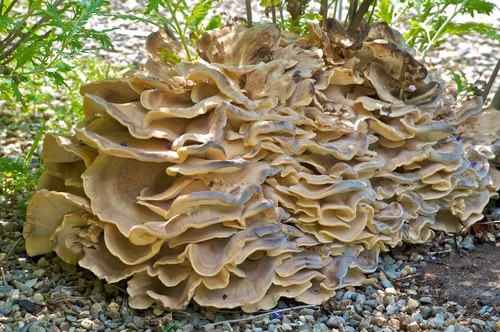
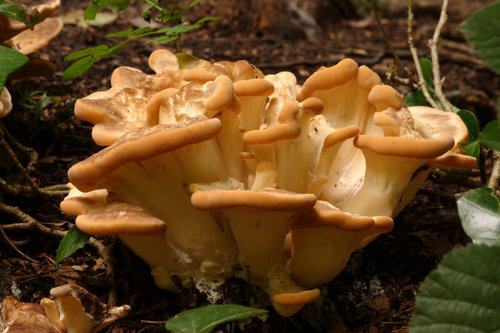
Meripilus giganteus (Pers.) P.Karst. produces basidiocarps formed of numerous rosette-like, flattened fan-shaped pilei. The whole fungal body typically measures 50–150 cm (20–59 in) across, and rarely reaches 250 cm (98 in) in diameter. Its total height is typically 10–50 cm (3.9–19.7 in), and rarely reaches 90 cm (35 in). Individual caps, which grow from a shared basal stem, can be up to 10–50 cm (3.9–19.7 in) across, rarely 90 cm (35 in) in diameter, and 1–5 cm (0.39–1.97 in) thick. The whole structure usually weighs 10–50 kg (22–110 lb), with the heaviest recorded specimen reaching 90 kg (200 lb). The surface of young caps is pale tan to dull chestnut brown, and darkens with age to form concentric brown zonate zones of varying shades. The cap surface is finely fibrillose and covered in small squamules. There are 3 to 6 pores per millimetre on the pore-bearing underside of the caps; the pore surface turns brown and black when bruised, a characteristic that helps distinguish this species from the similar species Grifola frondosa. Fruiting bodies emerge in autumn, and do not persist; they collapse into a slimy black mass after the first annual frosts. This fungus typically infects trees through a dead tap root, and wood decay is mostly limited to the tree's roots, especially the underside of roots. Infected trees often develop a thinned outer crown because root function is impaired. Whole tree failure occurs when degraded lateral roots become brittle and fracture. The fungus will continue to produce fruiting bodies on stumps or surface roots for several years after an infected host tree is felled. Under microscopic examination, spores are roughly spherical to ovoid or ellipsoid in shape, with typical dimensions of 6–6.5 × 5.5–6 μm. Spores are translucent (hyaline), smooth, and nonamyloid, meaning they do not take up stain from Melzer's reagent. The spore-bearing basidia are club-shaped, 4-spored, and measure 22–40 by 7–8 μm. This species has a monomitic hyphal system, meaning its fruiting body is composed entirely of vegetative hyphae, a trait that can help distinguish it from other polypore fungi. This mushroom grows on hardwoods, and only rarely occurs on conifers. In their European polypore monograph, Ryvarden and Gilbertson note it grows especially on Quercus and Fagus tree species. It has also been collected from the hardwood genera Acer, Aesculus, Alnus, Betula, Castanea, Celtis, Corylus, Eucalyptus, Laurus, Myrica, Persea, Pittosporum, Platanus, Populus, Prunus, Pyrus, Tilia, and Ulmus. It has additionally been found on the coniferous genera Abies, Larix, and Pinus. Meripilus giganteus has a circumboreal distribution across the northern hemisphere. It has been collected in Europe, Scandinavia, the area formerly known as the USSR, Iran, and Turkey. Many field guides incorrectly list it as occurring in North America, as this record comes from confusion with the related species Meripilus sumstinei; Meripilus giganteus is not actually found in North America. A study of wood-decay fungi on street and park trees in Hamburg, Germany found that this species was the most common wood-decay fungus recorded in the survey.