About Mergellus albellus (Linnaeus, 1758)
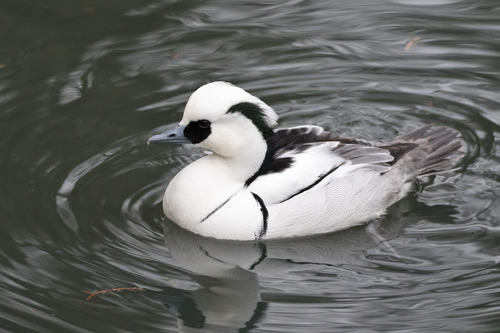
The smew, scientifically named Mergellus albellus (Linnaeus, 1758), measures 38–44 cm (15–17 in) in length, with a wingspan of 56–69 cm (22–27 in) and a weight of 450–650 g (16–23 oz). Adult male drake smews have an easily recognizable 'cracked ice' or 'panda' appearance, and appear distinctly black-and-white when in flight. Females and immature males are grey, with chestnut foreheads and crowns, white chins and cheeks, and black lores; these individuals are often called 'redhead' smew. Young males moult into adult plumage late in their first winter, when they are around 8–10 months old. In late summer and autumn, adult males grow eclipse plumage that makes them look similar to females, but they retain more white on their wings. When flying, smews show oval white patches on their wings. The smew's bill has a hooked tip and serrated edges, which help the bird catch fish when it dives for prey. This species breeds in the northern taiga of the Palearctic, ranging from northern Scandinavia east to Chukotka. It requires trees to breed, and lives on fish-rich lakes and slow rivers. As a migratory bird, it leaves its breeding grounds to winter on sheltered coasts or inland lakes. In Europe, its winter range includes the Baltic Sea, the Black Sea, northern Germany, the Low Countries, and Great Britain, where it occurs mainly in southeast England with some individuals reaching Scotland. In Asia, it winters on the Caspian Sea, in eastern China, Korea, and Japan, and a small number reach northern India. Vagrants have been recorded in northern Africa (Algeria, Egypt) and North America (Alaska, where it is regular in the Aleutian Islands, and Canada). On lakes, smews prefer edge areas, often positioned under small trees. Smew breed in May; females lay 7–11 cream-coloured eggs, which they incubate for 26–28 days. Ducklings leave the nest soon after hatching and develop the ability to fly around 10 weeks after hatching. The species nests in tree holes, such as old woodpecker nests. It is a shy bird that flushes easily when disturbed. The smew is one of the species covered by the Agreement on the Conservation of African-Eurasian Migratory Waterbirds (AEWA). It is not classified as threatened on the IUCN Red List, although its overall population is currently decreasing.