About Mercurialis annua L.
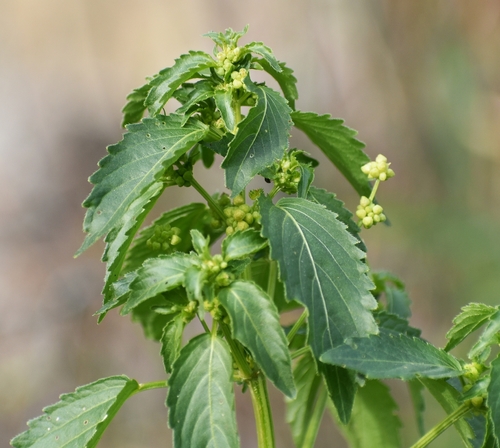
Mercurialis annua L., commonly called annual mercury, is an annual herb that typically grows 30–50 cm tall, and exceptionally reaches up to 1 m. It has an erect, branched stem with two strong longitudinal ridges that change sides at each node. The entire plant is more or less glabrous, and exudes watery sap when broken, unlike other members of the Euphorbiaceae which produce white latex. It is easily uprooted, revealing a bundle of thin, fibrous roots. Leaves are arranged in opposite pairs, with a short petiole around 1 cm long (exceptionally up to 4 cm), and tiny green stipules 1–2 mm long at the base. Each leaf is roughly 7 cm long by 3.5 cm wide, ovate with a pointed tip, and bears 4 to 18 blunt teeth along each margin, with a hydathode at the tip of each tooth. Annual mercury plants can be male, female, or hermaphrodite, forming dioecious, monoecious, gynodioecious, or androdioecious populations, a trait that is very unusual among plants. On male plants, flowers grow at the tips of long peduncles that emerge from leaf axils and extend beyond the leaves. On female plants, flowers grow in sessile clusters of 1 to 4 at branch nodes, or on short 4 mm pedicels. Hermaphrodite flowers, when present, have the same arrangement as female flowers; some are functionally female, producing no pollen or even lacking stamens entirely. Even in the northern parts of its range, annual mercury can usually be found flowering year-round. Flowers of both sexes have 3 perianth segments that resemble small yellowish-green petals about 2 mm long. Male flowers have 8–12 stamens that are somewhat longer than the tepals, with yellow anthers that turn black after pollen release. Female flowers have two ovaries and two styles, with bristle-tipped tubercles. The fruit is a schizocarp capsule up to around 4 mm long, with a warty, spiky outer coat that splits into two mericarps when mature. Each mericarp holds one shiny brown seed around 2 mm in diameter, with a caruncle at one end. As the mericarp dries and turns inside out, it explosively expels the seed, launching it roughly 30 cm from the parent plant; small seeds may travel as far as 130 cm. In Europe, the plant that most resembles annual mercury is dog's mercury. They do not share the same habitat: annual mercury is a weed of waste ground, while dog's mercury is a woodland plant, though they can sometimes occur close to each other, for example along woodland paths. The key differences are that annual mercury is easily uprooted, has branched stems, and is almost hairless except on leaf margins; dog's mercury is rhizomatous, unbranched, and usually hairy all over. Acalypha australis may look similar, but it has large shield-like bracts beneath its female flowers. Annual mercury is native to the Middle East and countries bordering the Mediterranean Sea, where it grows in desert and semi-arid regions, and has spread from this native range to disturbed agricultural soils and urban areas around the world. In the Arabian Peninsula, it grows on sandy soils in mountain valleys at an altitude of 1,200 m, reaching only 5 cm tall there. It is present in all mainland départements of France, where it is considered native, and introduced to Guadeloupe and Martinique; across all these areas, it is common and holds a conservation status of Least Concern (LC). In Britain, annual mercury occurs mainly in the south and east, but spread northward during the second half of the 20th century, becoming roughly three times as widespread. Towards the northern edge of its range, it is increasingly found as an urban weed, possibly benefiting from the urban heat island effect, and grows on pavements and rubble. The first British record of this species was made in 1538 by William Turner, and early records indicate it was not common at that time. Its conservation status in Britain is also Least Concern (LC). Annual mercury is native to arid regions around the Mediterranean, where it grows on bare, dry soil. Its fruit dispersal follows a three-stage process. First, exploding seedpods catapult seeds away, typically travelling around 30 cm from the parent plant. When seeds land, vibration from the impact attracts harvester ants of the genus Messor (in Italy, the species M. structor), which immediately collect the seeds and carry them to their nests, up to 5 m away. Ants remove the caruncle and deposit seeds in chambers within the nest. With the caruncle removed, seeds are ready to germinate, but will not do so until the third stage: an external event such as animal disturbance, flood, or ploughing destroys the ant nest. Soil from ant nests is particularly rich and friable, creating an ideal seedbed for new annual mercury plants. For this reason, annual mercury is especially common in agricultural land, where it acts not as a ruderal colonist of bare ground, but as a specialised inhabitant of regularly disturbed places. In the northern part of its range where harvester ants do not occur, and during the winter in the southern part of its range, it uses a different dispersal strategy. Seeds of annual mercury have an extremely low germination rate while the caruncle is present, but continued exposure to water for 48 hours allows a proportion of seeds to develop over a long period of time (2 weeks or more, compared to just one or two days for seeds from an ant nest). This allows annual mercury to act as a pioneer species, colonising new areas of bare ground when carried by floodwater. Habitats where it grows include Eastern Mediterranean limestone screes, old walls, and disturbed soils in little robin/hairy bittercress, nettle-leaved goosefoot, and hedge mustard vegetation communities. In Britain, annual mercury has spread northward from the south over recent centuries, first inhabiting warm micro-climates in urban areas. Here it often grows at the base of walls with a good nutrient supply, alongside plants such as black horehound, common mallow, and hedge mustard. It later spreads to arable fields and waste ground, and is recorded in the British National Vegetation Classification as occurring in OV6 sticky mouse-ear, OV9 scentless mayweed, and OV13 chickweed communities. Its Ellenberg values in Britain are L=7, F=5, R=7, N=7, S=0, which means it grows in well-lit, damp, neutral, richly fertile sites. Although generally considered wind-pollinated, male annual mercury plants can produce tens of thousands of flowers in one growing season, which generate large quantities of pollen and nectar, so a single plant may be visited by hundreds of insects each day. Host-specific pests and diseases can suggest the region where a plant evolved. The fungus Aecidium marcii Bubák, 1903 grows only on annual mercury, and is found only in Turkey among European countries, suggesting a Middle Eastern rather than pan-Mediterranean origin. The gall-forming fungus Leveillula chrozophorae Braun, 1984 is also restricted to the Middle East, though it is polyphagous on multiple spurge family species. Aleyrodes elevatus Silvestri, 1934 is a whitefly that spends part of its lifecycle on annual mercury or pellitory, and occurs throughout the Mediterranean. Across Europe, annual mercury is commonly infested with several generalist fungi, including the rusts Melampsora pulcherrima and the Melampsora populnea species aggregate, specifically the cryptic species M. rostrupii G.H. Wagner, known as dog's-mercury rust in Britain. Melampsora pulcherrima forms an orange coating on stems, while M. rostrupii produces small black dots on leaf surfaces. Another rust-like infection is caused by Synchytrium mercurialis (Libert) Fuckel, 1870, which forms glassy, golden warts and can distort leaves. Other fungi that grow on this plant include Cercospora mercurialis Passerini, 1877, which causes leaf mottling, and the rusts Puccinia cynodontis Lacroix, 1859 and P. isiacae (von Thümen) Winter, 1887. Among polyphagous insects that use annual mercury alongside other plants are the winter webworm and spurge hawk-moth, whose larvae eat the leaves, and the weevils Tropiphorus elevatus and Kalcapion semivittatum (Gyllenhal, 1833), whose larvae create large oval swellings inside stems or petioles. Laparocerus junonius Machado, 2007, L. rasus Wollaston, 1864, and L. roudieri Machado, 2007 have free-living larvae that feed on the roots of this and other plant species. Two aphids, the foxglove aphid and buckthorn aphid, feed on the foliage, while the fly Liriomyza bryoniae is a leaf miner. The only beetle specifically associated with annual mercury is Hermaeophaga cicatrix (Illiger, 1807). It is unknown whether annual mercury is poisonous to humans. The closely related dog's mercury is definitely poisonous, with recorded deaths after people mistook it for an edible herb like spinach. Livestock have also been recorded dying after eating a mercury species, but the specific species was not noted. Although annual mercury is not native to North America, some First Nations people in eastern Canada have used the plant's juice as a balm for wounds.