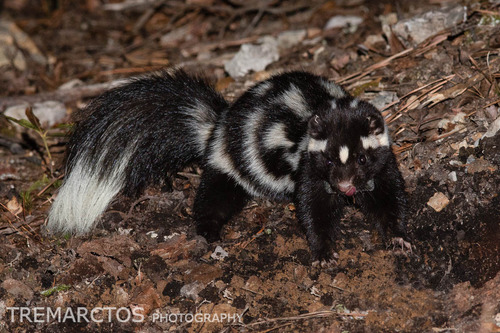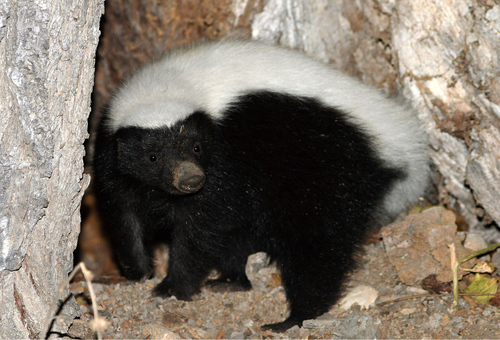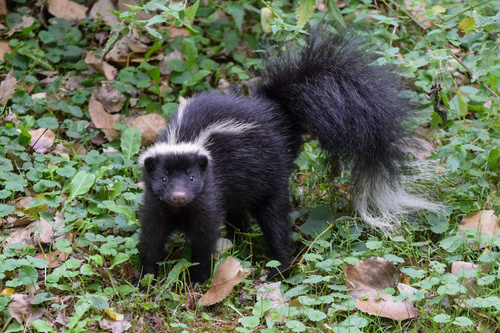
About Mephitis mephitis (Schreber, 1776)
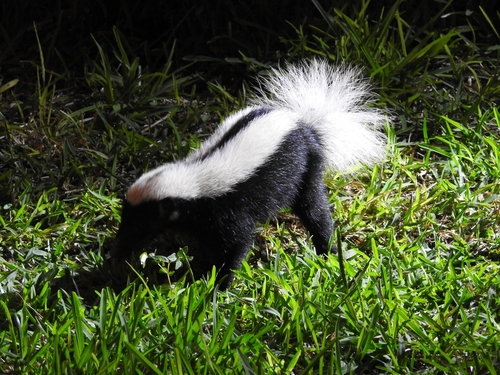
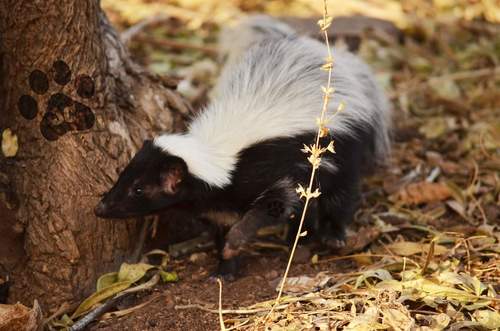
The striped skunk (Mephitis mephitis) is a stoutly built mammal with short limbs, a small conical head, and a long, heavily furred tail. Adult males are 10% larger than females; both sexes have a total body length between 52 and 77 centimetres (20 to 30 in), and typically weigh between 1.8 and 4.5 kg (4.0 to 9.9 lb), though some individuals can reach 5.5 kg (12 lb). Its feet are plantigrade with bare soles, and are not as broad or flat as the feet of hog-nosed skunks. The forefeet have five long, curved claws suited for digging, while hind foot claws are shorter and straighter. Fur color patterns vary widely, but most have a black base coat with a white stripe starting on the head that splits at the shoulders, then runs along the flanks to the rump and tail. Some specimens have a white chest patch, and others have white stripes on the outer surface of their front limbs. Brown or cream-colored fur mutations occur occasionally. Like all skunks, the striped skunk has two highly developed scent glands, one on each side of the anus. Each gland holds around 15 milliliters of musk, which it uses as a chemical defense against predators. This oily, yellow musk is made up of a mixture of strongly scented thiols (sulfur analogues of alcohols, previously called mercaptans), and can be sprayed several meters away. Ernest Thompson Seton compared the musk's odor to a thousand-times magnification of a mix of perfume musk, garlic essence, burning sulfur, and sewer gas, while Clinton Hart Merriam claimed it is not one tenth as offensive as the scent produced by minks and weasels. If sprayed into the eyes, the musk can cause a temporary burning sensation. The striped skunk lives in a wide range of habitats, most commonly mixed woodlands, brushy areas, and open fields broken up by wooded ravines and rocky outcrops. Some populations, especially those in northwestern Illinois, prefer cultivated areas over uncultivated land. The striped skunk is polygamous, and usually breeds once per year. Yearling females that do not successfully mate may go through a second estrous cycle one month after the first. The mating season generally runs from mid-February to mid-April, and is delayed at higher latitudes. Before mating, males' testicles swell between January and February, reaching maximum size in March. During this period, males travel long distances to search for females, sometimes covering 4 km (2.5 mi) in a single night. When a male finds a female, he approaches from the rear, licks her genitals, bites her nape, then copulates. A single male may hold a harem of multiple females, which he mates with and defends against other males for roughly 35 days. Once mating ends, pregnant females stay in their dens, while males work to rebuild their fat reserves. Gestation lasts around 59 to 77 days, and kits are born between mid-May and early June. Litters usually have 2 to 12 kits, averaging five or six; a litter of 18 has been recorded in Pennsylvania. Kits are born blind, with sparse fur, and weigh 25 to 40 grams. Their eyes open after around three weeks, and they are weaned between 42 and 56 days. Even though their scent glands are not yet developed, kits this age will instinctively take a defensive stance when threatened. After weaning, kits may accompany their mother outside the den, and become independent after 2 and a half months. The striped skunk is one of the most sought-after furbearers in North America, and was once the second most harvested furbearer after the muskrat. Its fur is naturally valuable, as it is durable and has a rich luster, though this luster fades with wear and sunlight exposure. Skunk pelts are sorted into four grades; the most prized pelts are those with a larger amount of black fur. Pelt values are further divided by locality, with the most valuable pelts coming from northern regions, where the fur is finer and darker. Skunks are known to be easy to trap, and will even approach traps they have been caught in before. Because killing a skunk without triggering it to discharge musk (which would ruin the fur) is difficult, trappers typically killed trapped skunks with a paralyzing blow to the lower back, or drowned them if caught in a box trap. Commercial skunk farming began in the late 1890s, when foreign demand for skunk skins was high, and intensive trapping had largely eliminated the more valuable mostly black specimens. Captive breeding of skunks was relatively simple compared to mink and marten farming, because skunks are easier to tame and have less specialized dietary needs. Farmers focused on selectively breeding the tamest and darkest colored individuals. Before World War I, skunk pelts were mostly shipped to Europe, until improved methods of deodorizing and processing skins led to greater interest in selling them for North American consumption. Though skunks are easy to breed and manage, skunk farming was not very profitable, as the relatively low price of pelts did not offset the cost of raising the animals. Even so, raising skunks was considered good practice for amateur fur farmers who planned to later work with more valuable furbearers such as martens, sable, mink, and silver foxes. Beyond fur use, the striped skunk was regularly eaten by trappers and Indigenous peoples, as long as the animal was not too old or had not sprayed before it was killed. American zoologist Clinton Hart Merriam described skunk meat as white, tender, sweet, and more delicate than chicken. The meat was valued by Chinese immigrants, who also purchased skunk gall bladders for medicinal use. Skunk fat was once regarded as an excellent lubricant. Skunk musk was historically used as a folk remedy for asthma, despite its extremely strong odor.