About Mephitis macroura Lichtenstein, 1832
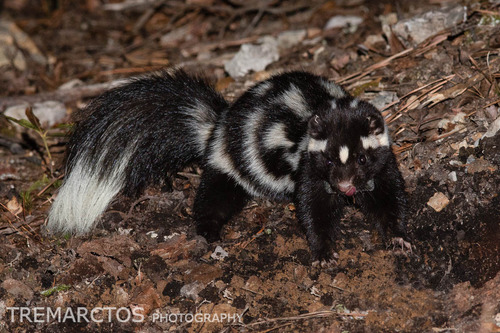
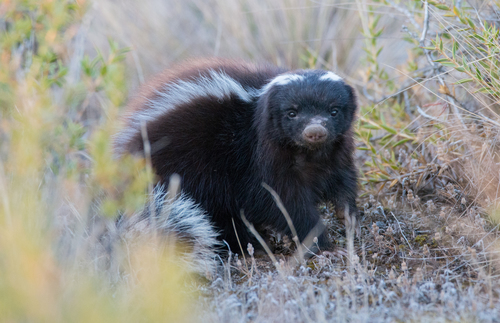
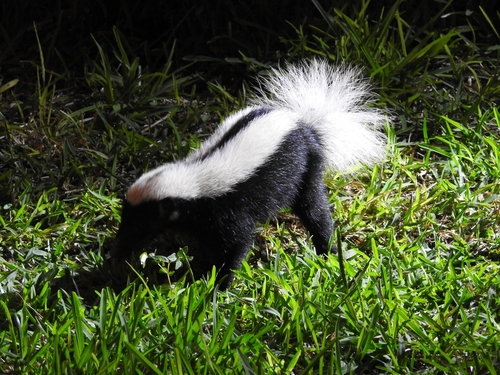
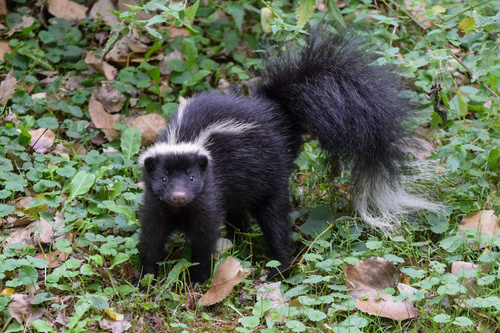
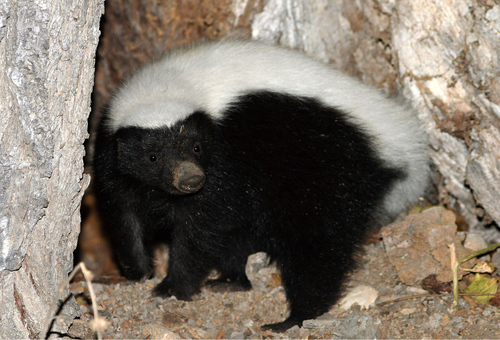
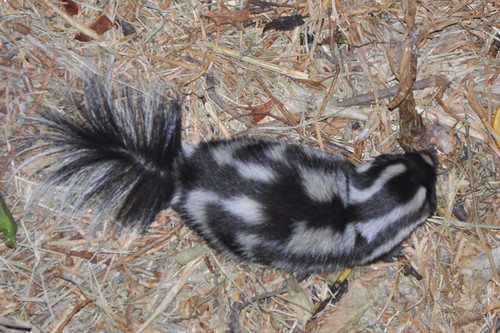
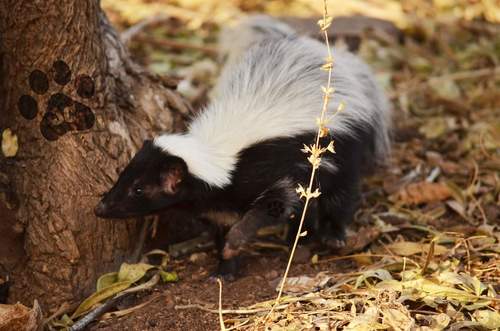
Morphology: The hooded skunk (Mephitis macroura Lichtenstein, 1832) can be distinguished from the closely related striped skunk (M. mephitis) by its longer tail, longer and much softer fur coat, and larger tympanic bullae. A ruff of white fur around its neck gives this species its common name. Three distinct color phases are documented for this species; all three phases have a thin white medial stripe between the eyes. The first phase is black-backed with two lateral white stripes, the second is white-backed with one dorsal white stripe, and the third is entirely black with only a few white hairs on the tail.
Characteristics: Hooded skunks are not currently classified as endangered. They are very abundant in Mexico, and can live in human suburban areas, most often on pastures and cultivated fields. Their fur has low economic value. However, their fat and scent glands are used in local folk medicine. In some parts of the species' range, their flesh is considered a delicacy. Other common names for the hooded skunk include mofeta rayada (Spanish), moufette à capuchon (French), pay (Maya), southern skunk, white-sided skunk, and zorillo.
Ecology: The hooded skunk's range extends from the Southwestern United States through Mexico, Guatemala, Honduras, and Nicaragua, to northwest Costa Rica. It is more abundant in Mexico than in other parts of its range. Individuals found in southern Mexico are more than 50% smaller than individuals from the Southwestern United States. Hooded skunks inhabit grasslands, deserts, and mountain foothills, and avoid high elevations. They tend to live near water sources such as rivers. Females are typically 15% smaller than males. The species' breeding season falls between February and March, and litter size ranges from three to eight young.