About Mentha suaveolens Ehrh.
Scientific Name and Height
Apple mint, scientifically named Mentha suaveolens Ehrh., typically grows 40 to 100 centimetres (16 to 39 inches) tall.
Growth Habit
It spreads via stolons to form clonal colonies.
Foliage Appearance
Its foliage is light green, with opposite, wrinkled, sessile leaves.
Leaf Dimensions and Shape
The leaves range from oblong to nearly ovate, 3 to 5 cm (1.2 to 2.0 in) long and 2 to 4 cm (0.8 to 1.6 in) broad.
Leaf Surface and Edges
Leaves are somewhat hairy on the upper surface, downy underneath, and have serrated edges.
Flower Inflorescence
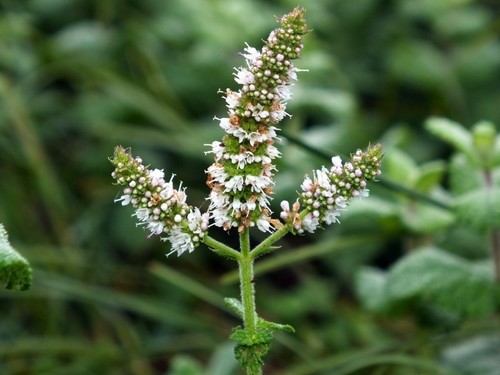
Flowers grow in terminal spikes 4 to 9 cm (1.6 to 3.5 in) long, made up of multiple whorls of white or pinkish flowers.
Bloom Period
Apple mint blooms from mid to late summer.
Aroma and Flavour
The whole plant is aromatic, with a fruity, minty flavour.
Native and Naturalised Range
Apple mint is native to southern and western Europe, and naturalised in central and northern Europe.
Habitat Preference
It grows in damp and wet locations.
Ornamental Use
As an attractive, hardy, easy-to-grow herb, apple mint is often grown as an ornamental plant.
Cultivation Light Requirements
It prefers growing conditions ranging from full sun to light shade.
Culinary Uses
Its leaves can be used to make apple mint jelly, act as a flavouring for dishes like apple mint couscous, be brewed into mint tea, used as a garnish, or added to salads.
Variegated Cultivar
Pineapple mint (Mentha suaveolens 'Variegata') is a cultivar of apple mint that has leaves banded with white.
Hybrid Cultivar
Grapefruit mint (Mentha suaveolens × piperata) is a hybrid derived from apple mint.
Medicinal Use History
Apple mint has been used for medicinal purposes for thousands of years across many regions of the world, including Africa, Europe, Asia, and the Americas.