About Mentha longifolia (L.) L.
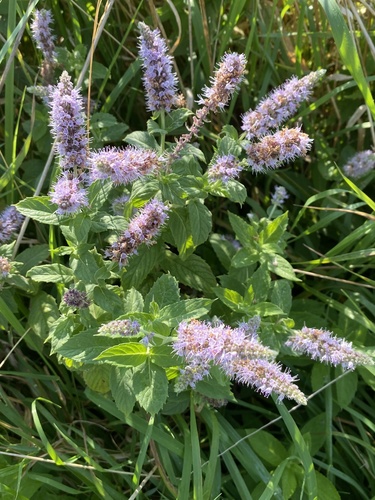
Mentha longifolia (L.) L. is a highly variable herbaceous perennial plant that produces a peppermint-scented aroma. Like many other mints, it has a creeping rhizome, and its stems grow between 40 and 120 centimeters tall, ranging from erect to creeping in shape. Its leaves range from oblong-elliptical to lanceolate, measuring 5 to 10 centimeters long and 1.5 to 3 centimeters broad. The leaves are covered in light to dense tomentose hairs, are green to greyish-green on the upper surface, and white on the lower surface. Its flowers are 3 to 5 millimeters long, and can be lilac, purplish, or white. The flowers grow in dense clusters called verticillasters, arranged on tall, branched, tapering spikes, and flowering occurs from mid to late summer. This species spreads through its rhizomes to form clonal colonies. Like almost all mints, Mentha longifolia can be invasive, so care should be taken when planting it in areas without growth containment. Historical medicinal uses of Mentha longifolia were recorded in Nicholas Culpeper's 1653 Complete Herbal, which notes that it is good for wind and colic in the stomach; that warm applied juice helps with King's evil or kernels in the throat; that its decoction or distilled water improves bad breath caused by tooth decay, and when snuffed up into the nose it purges the head; and that used with vinegar, it helps treat head scurf or dandruff. Like other species in the genus Mentha, Mentha longifolia is known to have important medicinal properties.