About Mentha aquatica L.
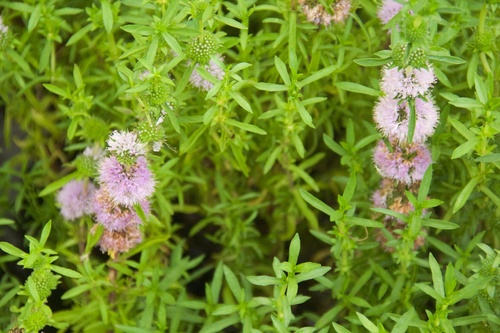
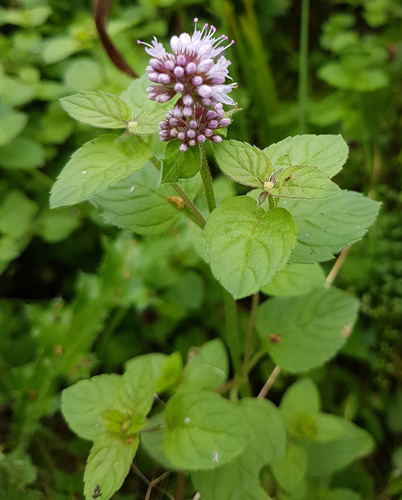
Mentha aquatica L., commonly called water mint, is a herbaceous, rhizomatous perennial plant that reaches 90 centimetres (35 in) in height. Its stems are square in cross-section, green or purple, and range from variably hairy to nearly hairless. It produces wide-spreading, fleshy rhizomes that bear fibrous roots. The leaves are ovate to ovate-lanceolate, 2 to 6 centimetres (0.79 to 2.36 in) long and 1 to 4 centimetres (0.39 to 1.57 in) broad; they are green (sometimes purplish), arranged oppositely along the stem, toothed, and also range from hairy to nearly hairless. Its flowers are tiny, densely clustered, tubular, and range in colour from pinkish to lilac (most commonly described as purple), forming a terminal hemispherical inflorescence. Flowering occurs from mid to late summer. Water mint attracts many types of insects, has a generalized pollination syndrome, and can also spread vegetatively via its underground rhizomes. All parts of the plant carry a distinctly minty scent. An unbranched, hairless variant with narrower leaves and paler flowers, native to Baltic Sea coastal areas of Sweden and Finland, is classified as Mentha aquatica var. litoralis. Mentha aquatica is a polyploid species, with a chromosome count of 2n = 8x = 96. Water mint is native to most of Europe, northern Africa, and western Asia, and has been introduced to North America, South America, Australia, and some Atlantic islands. As its common name suggests, water mint grows in shallow margins and channels of streams, rivers, pools, dikes, ditches, and canals, as well as in wet meadows, marshes, and fens. When it grows directly in water, it extends upward to rise above the water surface. It typically grows on mildly acidic to calcareous mineral or peaty soils, and is common on soft limestone. It can be found in specific fen-meadow habitats such as the Juncus subnodulosus–Cirsium palustre plant association. It is also a component of purple moor grass and rush pastures, a habitat type protected under the UK Biodiversity Action Plan. Water mint can be used as an edible herb, similar to spearmint or peppermint, and to make herbal tea. Its cultivated variety eau de Cologne mint, also called bergamot mint, is used to produce mentha citrata oil (bergamot mint oil), an ingredient used in perfumery, which is not the same as bergamot essential oil.