About Menemerus nigli Wesołowska & Freudenschuss, 2012
Menemerus nigli is a medium-sized jumping spider with a total body length of approximately 4.89 millimetres (0.193 in). Males are slightly smaller than females. For females, the cephalothorax (the forward body section) typically measures 2.82 millimetres (0.111 in), which is 0.1 millimetres (0.0039 in) longer than the male’s. The female’s abdomen, located behind the cephalothorax, measures 3.76 millimetres (0.148 in), which is 1.04 millimetres (0.041 in) longer than the male’s. The width of the carapace (the hard upper surface of the cephalothorax) is 2.06 millimetres (0.081 in) for both sexes. Abdomen width ranges between 3.06 and 3.16 millimetres (0.120 and 0.124 in) for both sexes.
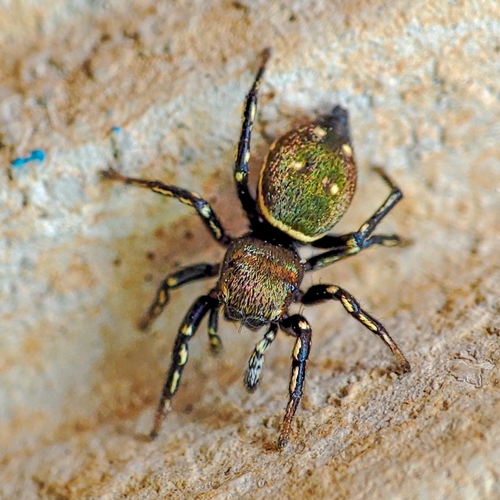
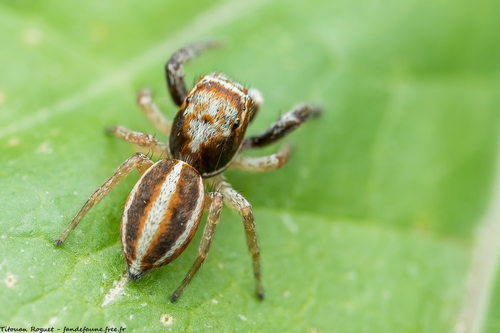
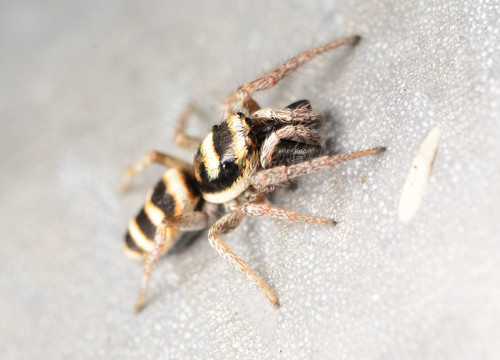
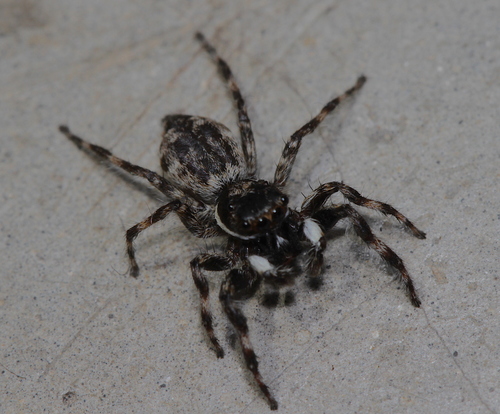
The carapace is dark brown, oval-shaped, and covered with white and fawn hairs. Dense white hairs form a pattern that creates a white streak across the spider, extending to the front of the carapace and its very low clypeus, a section of the spider’s face. The eye field is black, while the sternum (the underside of the cephalothorax) is light brown. The chelicerae are large, dark brown, and unidentate, meaning they have only one tooth on their rear margins. The spider’s remaining mouthparts, including the labium and maxillae, are light brown. Females have two teeth on the front of their chelicerae and long fangs.
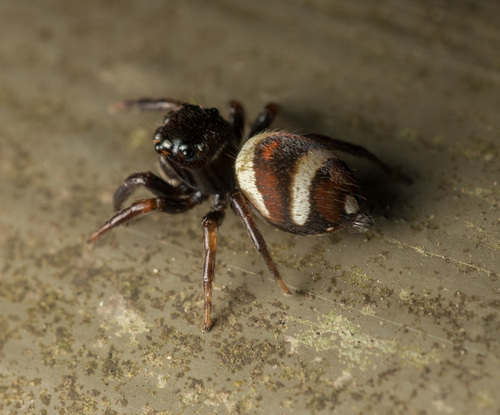
The abdomen is smaller and narrower than the carapace, and is brownish-grey. Males have six large patches on the upper surface of the abdomen. Females have cream markings and white hairs on the top of their abdomen, forming a distinctive pattern. The underside of the abdomen is grey with a few visible white hairs. Female spinnerets (structures used for spinning webs) are yellow, while male spinnerets are grey. The front legs are brown and stouter than the other legs; the remaining legs are yellow with brown patches. All legs are densely covered in brown and white hairs, and all leg spines are brown.
This species has distinctive copulatory organs. Males have large yellow pedipalps (sensory organs near the front of the body) covered in white hairs. The palpal tibia is short and bears a prominent projection called a tibial apophysis. The palpal bulb has an elongated oval-shaped tegulum, with a furrow running along its external surface between the haematodocha. A relatively long, thin projection called an embolus projects from the tegulum, with a large membranous conductor lying adjacent to it. Next to the tegulum is an elongated cymbium that acts as a protective covering for the palpal bulb; the cymbium is covered in short white hairs called setae. Females have broad bowl-like indentations in the epigyne, the visible external portion of their copulatory organs. There is an opening at the front of the epigyne, with a sharp fold on its inner wall that researchers Ali, Maddison, Zahid and Butt suggested may act as a guide for the male’s embolus. Copulatory openings connect via relatively large insemination ducts to round overlapping spermathecae (sperm receptacles) positioned in the middle of the epigyne. Two fertilisation ducts run internally perpendicular to the inner wall fold.
Menemerus nigli is similar to two other species in the same genus: Menemerus pilosus and Menemerus zimbabwensis, both native to Africa. It can be distinguished from these species by its abdominal pattern. Its embolus is larger than that of other species in the genus. Females are distinguished from other Menemerus species by the distinctive folds that extend from the broad forward-facing copulatory duct. Juvenile males are generally darker in overall appearance, and can be identified by the club-shaped cymbium on the ends of their pedipalps. Adult males have white hairs on the sides of their chelicerae.
The genus Menemerus is primarily African, with members found across Africa and Asia, and have also been recorded as far as Latin America. Menemerus nigli was first discovered in western Pakistan by Wanda Wesołowska and Mario Freudenschuss, and this find represented the second recorded example of the genus in Pakistan. The species has also been found in India and Thailand, with a confirmed range extending over 4,500 kilometres (2,800 mi). A specimen collected from West Bengal, India, was confirmed as Menemerus nigli via DNA barcode comparison in 2017; this was the fifth species of the genus recorded in India. The species was first recorded in Thailand in 2020. Many online images labelled as Menemerus fulvus may actually depict Menemerus nigli, so the species’ actual distribution may cover a wider area of south and south-east Asia than currently confirmed.
The species has also successfully established populations in Latin America. In 2020, Rafael M. Mariante and David E. Hill identified specimens of the species from three sites in Rio de Janeiro, Brazil. It is likely that the species arrived as an accidental migrant, carried along international trade routes. This long-distance introduction led Mariante and Hill to suggest the species has an even wider overall distribution. The species was first found living under stones. It has since been recorded living on stony ground, and synanthropically on indoor and outdoor walls in human settlements. It survives well in both ruins and currently inhabited areas, and particularly thrives on painted and stuccoed walls in cities such as Rio de Janeiro. Evidence that the species has found an established niche on human-made urban structures supports the idea that species able to adapt to human-created habitats are more successful when introduced to new, distant regions.