About Melothria scabra Naudin
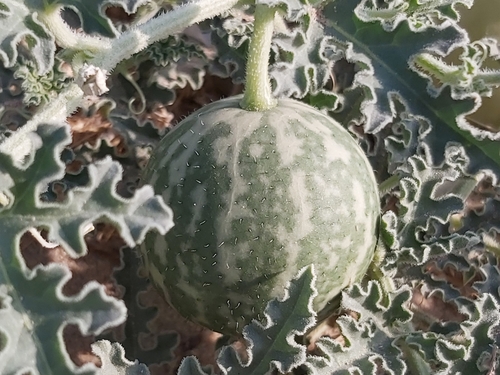
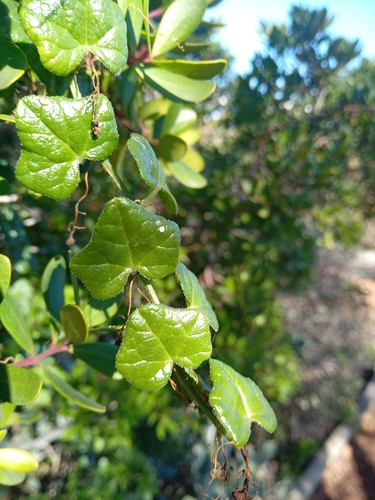
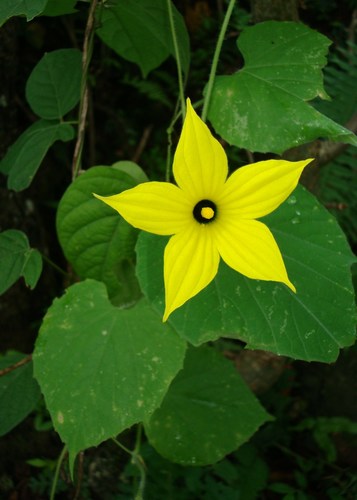
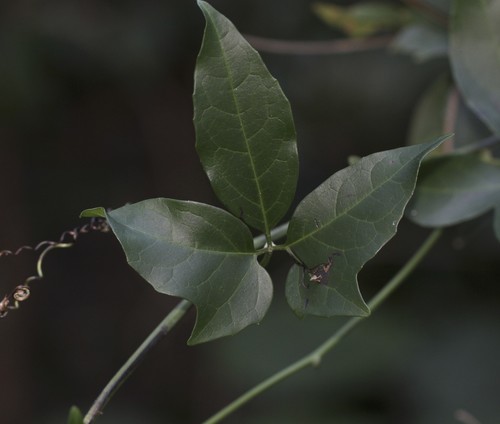
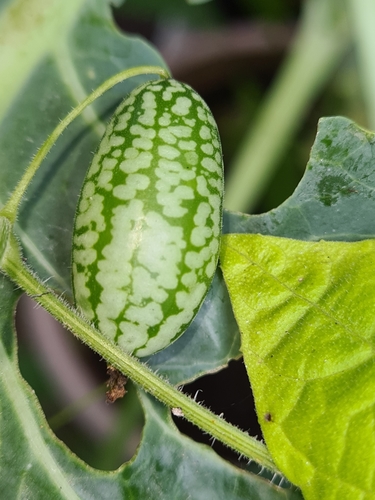
Melothria scabra Naudin is a vine with morphology similar to Melothria pendula. It has a climbing growth habit, and typically reaches 2.5–3 m (8.2–9.8 ft) in height. It grows quickly: under favorable conditions, germination takes approximately 10 days, and plants reach full maturity in approximately 60–75 days. It is a perennial species, but because it is not frost hardy, it is very often grown as an annual instead. Its leaves have three or five lobes, and measure 3–7 cm (1.2–2.8 in) in both length and width. The leaf margin is undulate or dentate, the leaf apex is caudate, and the leaf base is cordate. The leaf surface is scabrous, and the upper surface is covered in small hairs called trichomes. Like some varieties of cucumber, Melothria scabra is monoecious, meaning a single plant produces both male (staminate) and female (pistillate) flowers. Its flowers are small and yellow, reaching approximately 4 mm (0.2 in) in diameter. Unusually for cucurbits, female flowers develop before male flowers on this plant. Plants can self-pollinate overall, but individual flowers are not self-fertile. Each plant can produce hundreds of fruits, which develop at the base of female flowers, where the ovaries are inferior. Fruits are olive-shaped, growing to 2.5–4 cm (1.0–1.6 in) long and 1.5–2.5 cm (0.6–1.0 in) wide. They are green with dark green stripes. Unlike the fruits of most other wild species in the cucurbit family, Melothria scabra fruit has sweet rather than bitter flesh. Compared to other cucumbers, Melothria scabra plants are resistant to drought and pests. Melothria scabra is native to Colombia, El Salvador, Guatemala, Honduras, Mexico, Nicaragua, Panama, and Venezuela, where it naturally grows in forests and thickets. It is cultivated as a minor crop for its fruits, which are eaten raw or pickled.