About Melospiza melodia (A.Wilson, 1810)
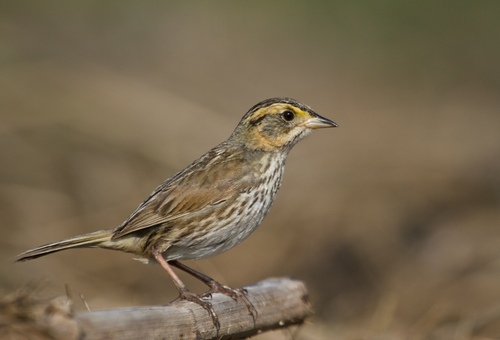
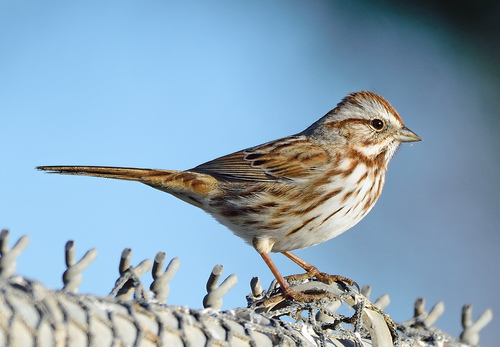
This species has the scientific name Melospiza melodia (A. Wilson, 1810). Adult song sparrows have brown upperparts with dark streaks on the back, white underparts with dark streaking, and a dark brown spot at the center of the breast. They have a brown cap, a long brown rounded tail, and gray faces with a brown streak running through each eye. Size varies highly across the species' many subspecies. Body length ranges from 11 to 18 cm (4.3 to 7.1 in), wingspan ranges from 18 to 25.4 cm (7.1 to 10.0 in), and body mass ranges from 11.9 to 53 g (0.42 to 1.87 oz). The average mass across all subspecies is 32 g (1.1 oz), while the widespread nominate subspecies M. m. melodia has an average mass of only around 22 g (0.78 oz). The maximum recorded lifespan of this species in the wild is 11.3 years. Song sparrow eggs are brown with greenish-white spots. Females lay three to five eggs per clutch, and eggs incubate for an average of 12–15 days before hatching. In field identification, song sparrows are most easily confused with Lincoln's sparrows and Savannah sparrows. Lincoln's sparrows can be distinguished by their shorter, grayer tails, different head patterning, and clear-cut angular brown patches on the cheeks. Savannah sparrows have a forked tail and yellowish flecks on the face visible when viewed up close. Though song sparrows are generalist habitat users, they favor brushland and marshes (including salt marshes) across most of Canada and the United States. They also thrive in human-dominated areas including suburbs, agricultural fields, and roadsides. Song sparrows are permanent residents in the southern half of their range. Northern populations migrate to the southern United States or Mexico for winter, where they mix with the local non-migratory population. The species is a very rare vagrant to western Europe, with a small number of records from Great Britain and Norway. Song sparrows forage on the ground, in shrubs, or in very shallow water. Their diet consists mainly of insects and seeds; populations in salt marshes may also eat small crustaceans. They nest in sheltered locations either on the ground, or in trees or shrubs. Song sparrows with shrub cover in their territory that is located away from the intertidal coastline have higher over-winter survival and greater reproductive success.