About Melospiza lincolnii (Audubon, 1834)
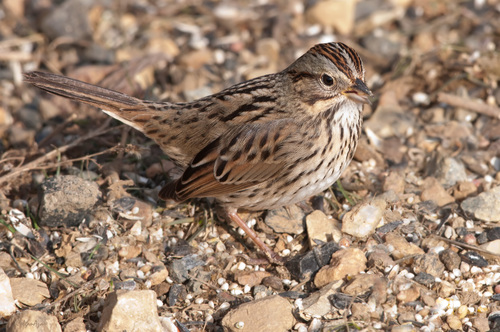
Adults of Melospiza lincolnii (Lincoln's sparrow) have dark-streaked olive-brown upperparts, a light brown breast with fine streaks, a white belly, and a white throat. They have a brown cap with a central grey stripe, olive-brown wings, and a narrow tail. Their face is grey with brown cheeks, a buffy mustache stripe, a brown line through the eye, and a narrow eye ring. Males and females have identical plumage. They are somewhat similar in appearance to song sparrows, but are smaller, trimmer, and have finer breast streaks. Juveniles strongly resemble juvenile swamp sparrows, with a streaky chest and no buffy breast yet, but Lincoln's sparrows rarely have a solid unicolored crown like swamp sparrows do. Adult measurements are: length 5.1–5.9 in (13–15 cm); weight 0.6–0.7 oz (17–19 g); wingspan 7.5–8.7 in (19–22 cm).
This species' breeding habitat occurs in subalpine and montane zones across Canada, Alaska, and the northeastern and western United States, and it is less common in the eastern portions of its range. It is found mainly in wet thickets, shrubby bogs, and moss-dominated habitats, and prefers areas near dense shrub cover. Nests are well-concealed shallow open cups built on the ground under vegetation. At lower elevations, it can also be found in mixed deciduous groves, mixed shrub-willow stands, and black spruce-tamarack bogs. It primarily forages on the ground and at the base of willows, and sings from tall trees and willow branches. During migration, it lives in thickets and bushes, particularly in riparian zones, and uses lowland areas including the Great Plains and Great Basin, as well as urban and suburban habitats in the eastern United States. Migration starts between May 13 and 30, and lasts until August 20 to September 20. Winter habitats in the southern portion of the species' range include tropical evergreen and deciduous forests, arid and humid pine-oak forests, Pacific swamp forests, and arid subtropical scrub. The wintering range extends from the southern United States south to Mexico and northern Central America, and the species is a passage migrant across most of the United States except the western part of the country. In 2010, a Lincoln's sparrow was observed for the first time in the Dominican Republic, and there are also several records of the species from montane regions of Haiti. However, the bird's skulking behavior and preference for densely vegetated habitats makes it difficult to accurately map the species' full range.
For reproduction, males arrive at breeding grounds in mid to late May and begin singing to attract mates. In early June, females build nests on the ground under dense grass or shrub cover, usually inside a low willow shrub, mountain birch, or sunken into a depression in sphagnum moss. The nest is a well-concealed shallow open cup made of grasses or sedges. Clutch size is typically 3 to 5 eggs, which are oval, pale green to greenish-white, and spotted with reddish brown. Females lay one egg per day, and begin incubating eggs before the clutch is complete; males do not take part in incubation. Incubation lasts about 12 to 14 days. Hatchlings are altricial, and leave the nest about 9 to 12 days after hatching, though they may be cared for by their parents for an additional 2 to 3 weeks. Fledglings are mostly flightless on their first day out of the nest, but their flying ability improves quickly, and they can fly more than 10 meters at a time by six days after leaving the nest. In this species, male bill shape is correlated with song quality: song quality declines as the ratio of bill height to bill width decreases. This affects reproductive success, because song quality influences female mating preferences. Males that hatch later in the breeding season tend to have bill shapes that are less suitable for producing songs attractive to females, and thus have lower reproductive success.