About Melolontha melolontha (Linnaeus, 1758)
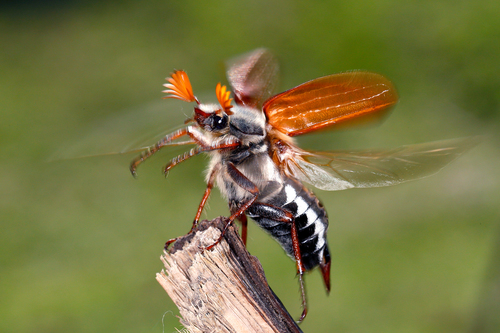
The common cockchafer, scientifically named Melolontha melolontha (Linnaeus, 1758), is also known colloquially as the Maybug, Maybeetle, or doodlebug. It is a scarab beetle species in the genus Melolontha, native to Europe. It is one of several closely related, morphologically similar Melolontha species called cockchafers, alongside the forest cockchafer, Melolontha hippocastani. This species develops through complete metamorphosis, progressing through four life stages: egg, larva, pupa, and adult. Mating behavior in this species is controlled by pheromones. During mating season, males typically swarm, while females remain stationary and feed on leaves. When females feed on leaves, the leaves release green leaf volatiles that males can detect to locate females for mating. Larvae use both plant volatiles and carbon dioxide to find plant roots to feed on. Common cockchafers are an important, nutritious food source for many other animal species. Both adults and larvae feed on plants, so the species is considered an agricultural pest that affects crops including grasses and fruit trees. When adults aggregate in large groups, they cause significant damage to crops. Larvae damage plants severely and can even kill plants by gnawing through their roots. Common cockchafers are widespread across Europe, including in Germany, France, and the United Kingdom. They are especially common in temperate regions that have soil conditions suitable for larval development. They have also been recorded in parts of Asia, including Turkey and the Caucasus region. Geographical barriers, climatic conditions, and ecological factors likely limit their dispersal to other continents. Adult common cockchafers emerge in late April or May, and live for approximately five to seven weeks. Around two weeks after emerging, females begin laying eggs, which they bury 10 to 20 centimeters deep in soil. Females may lay eggs in multiple batches until they have laid a total of 60 to 80 eggs, and most often lay eggs in open fields. Adult common cockchafers prefer oak leaves as food, but will also feed on conifer needles. Larvae, called "chafer grubs" or "white grubs", hatch four to six weeks after eggs are laid. They feed on plant roots, including potato roots. Larvae develop underground over three to four years, and may take up to five years to develop in colder climates. They grow continuously to reach a final size of about 4–5 centimeters, then pupate in early autumn. They develop into fully formed adult cockchafers six weeks after pupation. Common cockchafers overwinter underground at depths between 20 and 100 centimeters, and only move up toward the soil surface in spring. Due to their long larval development period, adult common cockchafers emerge on a three or four year cycle, with the exact cycle timing varying between regions. A larger 30-year cycle is also superimposed on this shorter cycle, during which unusually high numbers (tens of thousands) of cockchafers emerge; this high-abundance cycle was historically recorded, but it is unclear if it still occurs today. Adult common cockchafers feed on the leaves of deciduous plants and fruit trees, including oaks, maples, sweet chestnuts, beeches, plums, and walnuts. Larval feeding causes severe damage to plants. Larvae feed on both small roots of field plants including grain, grass, and trees, as well as beet roots and large crop rootlets. Larvae can gnaw through up to 30 centimeters of root per day, which quickly kills the host plant.