About Meloe variegatus Donovan, 1793
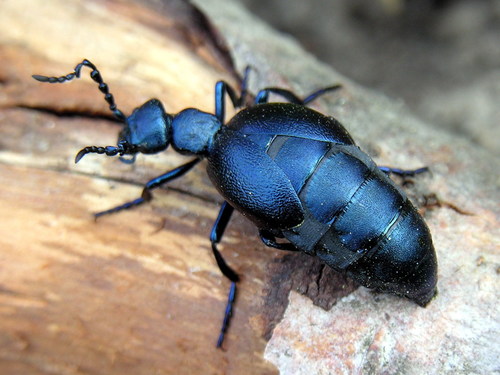
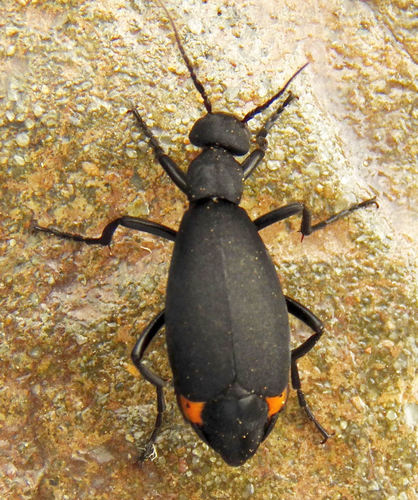
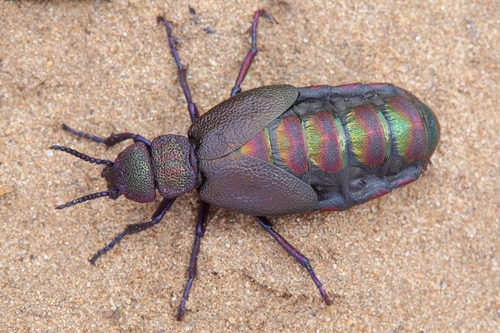
Meloe variegatus Donovan, 1793 is a flightless beetle species with short elytra that overlap at the front. Its exposed upper abdominal segments have bright coloration. Like all species in the genus Meloe, it releases a smelly, oily fluid when it feels alarmed. This species is active between April and July, and inhabits grassy areas where it chews the leaves of various plants. It is considered a pest of sugar beet, cabbage, and winter rye. Meloe variegatus is classified as regionally extinct in the United Kingdom, and can still be found in central Europe and the Iberian peninsula. The larvae of Meloe variegatus primarily parasitize the nests of solitary bees, though they have also been recorded in a social bee colony in Poland. After fertilized eggs are laid, first instar larvae hatch after 24 hours. The larvae climb to the top of a nearby blade of grass or flower and stay immobile until they can attach to a passing bee with their mouthparts. They puncture the bee’s intersegmental membranes to feed on the bee’s haemolymph, and up to 15 larvae have been observed on a single bee. Later larval growth stages of M. variegatus are not parasitic; instead, they feed on the food stores collected by the bees. The larvae pupate inside solitary bee nests, but they are rarely able to pupate in larger social bee colonies because worker bees remove them. In the early 19th century, this species was used in Germany as an unproven cure for rabies, which was called hydrophobia by William Elford Leach. To collect the oily secretion the beetles produce, they were hung by the neck until dry, after which the secretion was prepared and administered. This species was also thought to act as a diuretic.